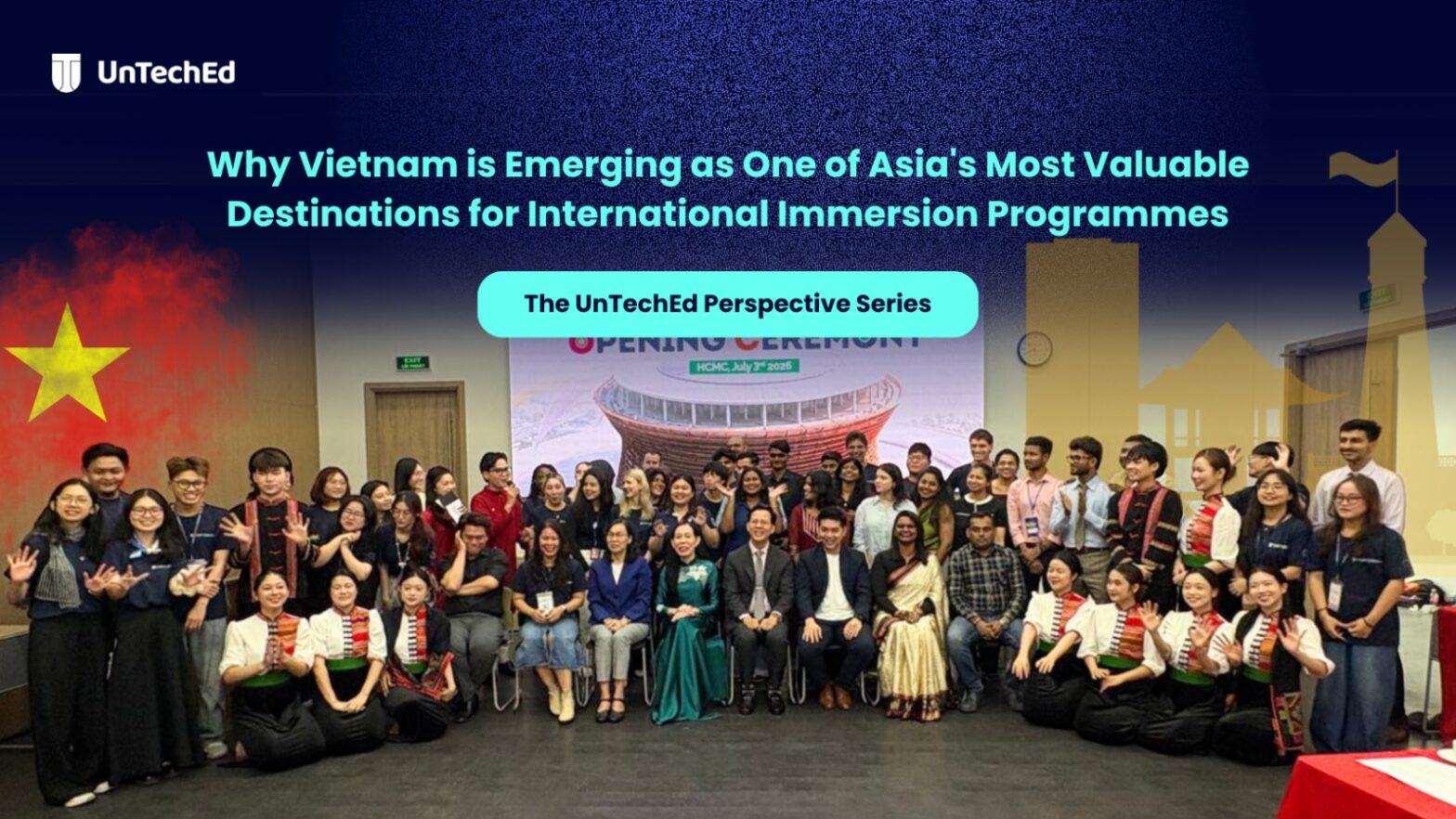
The Unteched Perspective Series
For many years, countries such as Singapore, the United Kingdom, Australia, and the United States have been the preferred destinations for international academic exposure. While these destinations continue to offer exceptional learning opportunities, universities today are increasingly looking for experiences that are practical, affordable, industry-focused, and aligned with the changing realities of Asia’s economic landscape.
One destination that has quietly emerged as an outstanding choice is Vietnam.
Often recognised for its rich history, vibrant culture, and breathtaking landscapes, Vietnam has transformed itself into one of Asia’s fastest-growing economies. Beyond tourism, it has become a destination where students can witness rapid industrialisation, entrepreneurship, technology adoption, manufacturing excellence, sustainability initiatives, and international business expansion.
At Unteched, we believe an immersion programme should go beyond classroom learning. It should provide students with meaningful exposure to new academic environments, industries, cultures, and ways of thinking. Vietnam offers a unique combination of all these elements.
Vietnam’s story over the past two decades is remarkable.
The country has evolved into one of Asia’s most dynamic economies, attracting significant global investment while developing strong capabilities in manufacturing, technology, logistics, renewable energy, tourism, healthcare, and innovation.
For students, this presents an opportunity to understand how a nation can successfully balance economic growth, international investment, and local entrepreneurship.
An immersion programme in Vietnam is not simply about visiting another country—it is about observing transformation in real time.
Students experience firsthand how education, government, and industry work together to support innovation and economic development.
One of Vietnam’s greatest strengths is its relevance across multiple academic disciplines.
Business and Management
Students can explore:
Vietnam provides valuable insights into how businesses expand in emerging markets and how international companies operate within Southeast Asia.
Engineering and Technology
Vietnam has become an important manufacturing and technology hub.
Students gain exposure to:
Industry visits allow learners to connect classroom concepts with real-world applications.
Hospitality and Tourism
Vietnam’s tourism sector demonstrates how heritage, sustainability, hospitality, and innovation can coexist.
Students studying hospitality, tourism, and event management can observe:
Healthcare and Allied Sciences
Vietnam continues to strengthen its healthcare infrastructure while integrating technology into patient care and medical education.
Students can explore:
Design, Architecture and Urban Development
Cities such as Ho Chi Minh City showcase rapid urbanisation while preserving cultural identity.
Students can learn about:
Learning Beyond the Classroom
An international immersion programme should combine academic knowledge with practical experience.
In Vietnam, students have opportunities to participate in:
These experiences encourage students to think critically, communicate across cultures, and develop confidence in unfamiliar environments.
Cultural Intelligence Matters
Today’s employers increasingly value graduates who can work with people from different backgrounds.
Vietnam offers students an opportunity to experience:
Developing cultural intelligence is becoming as important as developing technical knowledge.
Universities are increasingly seeking destinations that provide strong academic value while remaining accessible for larger groups of students.
Vietnam offers several advantages:
This combination makes Vietnam particularly suitable for short-term international immersion programmes.
Ho Chi Minh City is one of Southeast Asia’s most vibrant commercial and educational centres.
It provides students with opportunities to experience:
For students interested in business, technology, management, and innovation, Ho Chi Minh City offers an exceptional learning environment.
As part of Unteched’s commitment to creating meaningful global learning experiences, we are delighted to collaborate with Van Lang University, Ho Chi Minh City, Vietnam.
Van Lang University is recognised for its modern learning environment, international outlook, industry engagement, and emphasis on experiential education.
Through this collaboration, students will participate in:
The partnership reflects our shared belief that international education should be practical, collaborative, and globally relevant.
We are pleased to announce that Unteched will be leading two student immersion groups to Van Lang University in Ho Chi Minh City later this year.
These programmes have been designed to provide students with a balanced learning experience that combines academic enrichment, industry exposure, cultural understanding, and international networking.
Participants will have the opportunity to:
Each programme has been carefully curated to ensure that learning continues beyond lectures and becomes an experience students carry throughout their academic and professional journeys.
Vietnam has emerged as one of Southeast Asia’s fastest-growing economies, making it an ideal destination for students to understand international business, innovation, manufacturing, entrepreneurship, and sustainable development. Beyond its economic growth, Vietnam offers universities an opportunity to combine academic learning with industry exposure and cultural understanding.
Students not only experience a different educational environment but also witness how global companies operate, how local businesses are expanding internationally, and how emerging economies are shaping the future of Asia. For universities looking to provide meaningful international exposure at an accessible cost, Vietnam offers an excellent balance of academic value, industry engagement, and cultural immersion.
One of Vietnam’s greatest strengths is its relevance across multiple disciplines.
Students from Business, Management, Engineering, Information Technology, Hospitality, Tourism, Healthcare, Architecture, Design, Media, and Entrepreneurship can all benefit from the country’s rapidly evolving economy.
Because the programme combines university learning with industry visits and cultural experiences, students gain practical insights that complement their classroom education while developing transferable skills such as adaptability, communication, teamwork, and intercultural awareness.
Ho Chi Minh City is Vietnam’s commercial and financial centre, offering students exposure to modern businesses, international organisations, innovative start-ups, and leading universities.
The city reflects Vietnam’s transformation into a globally connected economy while maintaining its cultural heritage. Students can experience contemporary urban development alongside historical landmarks, providing a deeper understanding of how economic growth and cultural identity coexist.
For many students, Ho Chi Minh City becomes a living classroom where academic concepts are connected to real-world practice.
Although every programme is designed according to the university’s academic objectives, a typical immersion programme may include:
The objective is to create a balanced learning experience that combines academic knowledge, professional exposure, and cultural understanding.
At Unteched, we believe meaningful international experiences are built through strong academic partnerships.
Our collaboration with Van Lang University in Ho Chi Minh City is based on a shared commitment to experiential learning, international engagement, and preparing students for an increasingly global future.
Through this partnership, participating students benefit from academic sessions, campus interactions, collaborative learning opportunities, and exposure to Vietnam’s dynamic educational and business environment.
Rather than simply visiting another country, students become part of an academic experience that encourages dialogue, collaboration, and global learning.
The duration of an immersion programme depends on the learning objectives of the institution.
Many universities choose programmes lasting between five and seven days, while others prefer longer experiences that include additional industry visits, collaborative projects, or regional travel.
The most effective programmes maintain a balance between academic engagement, professional exposure, and cultural experiences without overwhelming students with excessive travel.
Vietnam is widely recognised as a welcoming destination for international visitors and has become an increasingly popular location for educational travel.
Like any international destination, universities should work with experienced programme organisers, follow institutional travel policies, and encourage students to observe local guidelines and cultural practices.
With appropriate planning and support, Vietnam offers a comfortable environment for international student groups.
Employers increasingly seek graduates who can adapt to international environments, communicate across cultures, solve problems collaboratively, and understand global markets.
Immersion programmes provide opportunities for students to develop these competencies through real-world experiences, industry engagement, and exposure to different academic and professional settings.
Students often return with greater confidence, stronger communication skills, broader perspectives, and a better understanding of international workplaces—qualities that complement their academic qualifications.
Yes.
Every institution has different academic priorities, student profiles, and learning outcomes.
Programmes can be designed around specific disciplines, industry sectors, faculty objectives, or institutional goals. Academic sessions, company visits, cultural experiences, and networking opportunities can all be tailored to create a meaningful and relevant experience for participants.
Customisation ensures that each programme supports the university’s broader internationalization strategy rather than offering a generic study tour.
Internationalization extends far beyond student mobility.
Well-designed immersion programmes contribute to institutional goals by strengthening international partnerships, encouraging faculty collaboration, creating opportunities for future research, enhancing curriculum relevance, and preparing students for global careers.
They also help universities build long-term relationships with international institutions, opening pathways for future exchanges, collaborative projects, and academic initiatives.
When aligned with a university’s strategic vision, immersion programmes become an important component of sustainable international engagement rather than standalone international visits.
Every university’s internationalization journey is unique.
If your institution is exploring international immersion programmes, academic collaborations, or global partnerships in Vietnam, our team would be delighted to discuss how a programme can be designed to meet your academic objectives, student outcomes, and long-term internationalization goals.
We also invite university leaders, faculty members, and international offices to share their questions with us. Selected questions will be answered in future editions of The Unteched Perspective Series, helping create a growing knowledge resource for the higher education community.
At Unteched, we believe international immersion programmes should create transformation, not just travel.
A successful programme enables students to see the world differently, appreciate diverse perspectives, understand global industries, and return home with greater confidence, curiosity, and readiness for an interconnected future.
Vietnam represents exactly this kind of opportunity.
Its remarkable economic growth, educational development, entrepreneurial energy, and cultural richness make it one of Asia’s most exciting destinations for international learning.
As we prepare to welcome two new student cohorts to Van Lang University in Ho Chi Minh City, we look forward to continuing our mission of helping universities create meaningful global learning experiences that inspire the next generation of leaders.
Every country has a unique story to tell, and every immersion programme offers a different learning experience.
In the coming weeks, The Unteched Perspective Series will continue exploring how destinations across Asia and beyond can contribute to internationalization in higher education, helping universities make informed decisions about creating impactful global learning opportunities for their students.