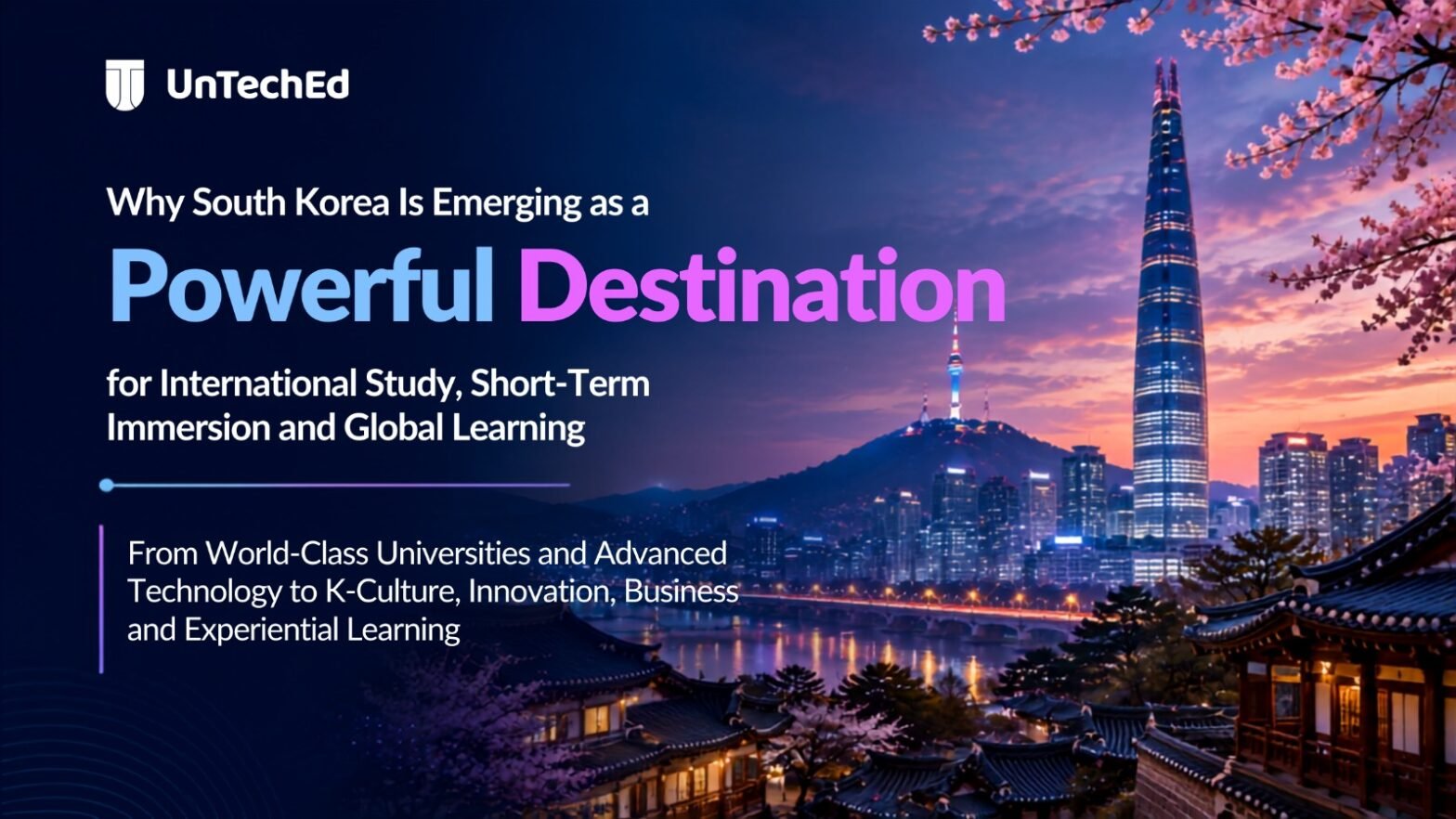
When students think about South Korea, many immediately think of K-pop, K-dramas, Samsung, Hyundai, technology, Korean food and Seoul.
But something much bigger is happening.
South Korea has transformed itself from a country once known primarily for rapid industrialisation into one of the world’s most technologically advanced, research-intensive and globally connected economies. Today, it is also making a deliberate push to become a major international education destination.
And the numbers are significant.
South Korea had 253,434 international students in 2025, up from 91,332 in 2015. That means the international student population has almost tripled in a decade. More importantly, the number crossed 200,000 in 2024 and continued growing strongly in 2025.
The Korean government is actively supporting this expansion through its Study Korea 300K Project, which aims to attract 300,000 international students by 2027 and position Korea among the world’s leading study destinations.
But there is a more interesting question for students, parents and universities:
Why should South Korea be considered not simply as a country to visit, but as a country from which to learn?
That is where South Korea becomes particularly interesting.
South Korea Is Not Just a Study Destination. It Is a Living Case Study.
South Korea itself can be considered a classroom.
Think about the transformation.
In a few generations, Korea developed globally competitive industries in:
At the same time, Korean companies and cultural products have developed extraordinary global reach.
For a student, this creates an unusual learning environment.
You are not simply reading about:
innovation.
You can experience an innovation ecosystem.
You are not simply studying:
digital transformation.
You are living in one of the world’s highly digitised economies.
You are not simply learning:
global branding.
You are surrounded by Korean brands that have successfully built international audiences.
And you are not simply studying:
cultural influence.
You are experiencing the global phenomenon known as Hallyu — the Korean Wave.
This combination makes South Korea particularly attractive for international immersion programmes, semester-abroad programmes and longer-term study.
The growth is not just a marketing story.
According to the Korean government’s official Study in Korea statistics, the number of international students in Korean higher education and related programmes has grown as follows:
Year | International Students |
|---|---|
2015 | 91,332 |
2019 | 160,165 |
2022 | 166,892 |
2023 | 181,842 |
2024 | 208,962 |
2025 | 253,434 |
That represents an increase of almost 178% between 2015 and 2025.
And the growth is not confined to undergraduate education.
In 2025, Korea recorded:
This is important because it demonstrates that South Korea is developing a complete international education ecosystem, rather than attracting only short-term visitors.
The Korean government launched the Study Korea 300K Project with a clear target:
300,000 international students by 2027.
The strategy goes beyond simply recruiting students.
The Korean Ministry of Education describes the approach as covering the international student’s journey from:
Recruitment → Education → Academic Support → Career Planning → Employment/Settlement
The government has also connected international student recruitment with:
This is significant for international students.
It suggests that Korea is increasingly thinking about international students not simply as temporary visitors, but as part of its broader education, innovation and economic ecosystem.
There are several reasons.
1. Globally Recognised Universities
South Korea has developed a strong group of internationally recognised universities.
Current QS rankings place institutions including:
among internationally ranked Korean universities.
In the current QS listings, Seoul National University is ranked #38 globally, Yonsei University #42, Korea University #52 and KAIST #65.
This provides students with something important:
academic credibility + international exposure.
But rankings should not be the only reason to choose a university.
The better question is:
What does this university offer that matches my academic and career goals?
Seoul: One of Asia’s Most Interesting Student Cities
For international students, Seoul offers an unusual combination:
University city + technology hub + business centre + cultural capital + global city.
The city is home to several internationally ranked universities, including Seoul National University, Yonsei, Korea University, Sungkyunkwan and Hanyang.
But the city itself becomes part of the learning experience.
A student can move between:
within a relatively compact metropolitan environment.
For an immersion programme, that is extremely valuable.
If there is one area where South Korea stands out particularly strongly, it is:
Technology and innovation.
According to OECD data, Korea’s gross domestic expenditure on R&D reached approximately 5.13% of GDP in 2024, among the highest levels recorded by any OECD economy.
For comparison, OECD-wide R&D intensity was approximately 2.72% in 2024.
That means Korea’s R&D intensity was almost twice the OECD average.
This investment helps explain why Korea has become a global force in areas such as:
The OECD describes Korea as particularly strong in key technologies including semiconductors, 6G and ICT infrastructure.
For engineering and technology students, therefore, South Korea isn’t simply a destination.
It is a real-world technology case study.
South Korea and the Semiconductor Economy
Few technologies are as important to the modern global economy as semiconductors.
They are essential to:
Korea is one of the world’s major semiconductor economies.
The OECD notes that the semiconductor value chain is highly concentrated globally and identifies Korea as a key player, particularly in memory chips. Advanced logic-chip production is concentrated among a very small number of global producers, including Samsung in Korea and TSMC in Chinese Taipei.
This gives engineering, electronics, computer science and business students an extraordinary opportunity to understand:
That question is much bigger than semiconductors.
It involves:
South Korea for Engineering Students
South Korea is particularly relevant for students studying:
An immersion programme can connect academic learning with real-world applications in:
Semiconductors
Robotics
AI
Smart manufacturing
Electric vehicles
Battery technology
Digital infrastructure
Advanced electronics
This is where the Korean destination becomes academically powerful.
South Korea for AI and Computer Science Students
Artificial intelligence is becoming central to Korea’s education and industrial strategy.
In 2026, the Korean Ministry of Education’s advanced-industry talent programmes expanded AI-linked training across areas such as semiconductors, biotechnology, batteries, displays, aerospace, future vehicles and robotics.
That tells us something important.
AI is not being treated simply as a computer science subject.
It is increasingly being integrated into:
This is exactly the type of interdisciplinary learning that future graduates will need.
South Korea for Business Students
Technology is only one side of Korea’s story.
The country also provides an interesting case study in global business strategy.
Consider companies such as:
These companies provide examples of how businesses from one relatively small domestic market can build global operations.
Business students can explore:
Global branding
How does a Korean brand become globally recognisable?
Internationalisation
How does a company expand into multiple countries?
Supply chains
How are global manufacturing networks created?
Innovation
How does R&D translate into commercial products?
Consumer behaviour
How do Korean companies adapt products for different markets?
Corporate strategy
How do large Korean conglomerates compete internationally?
This makes South Korea particularly relevant for:
MBA students + BBA students + commerce students + economics students + marketing students + entrepreneurship students.
South Korea’s major business groups, often referred to as chaebol, are a distinctive part of its economic development.
Students can explore how large family-linked corporate groups contributed to Korea’s industrialisation and global expansion.
This raises fascinating questions:
These are excellent discussion topics for business immersion programmes.
South Korea and Entrepreneurship
Korea is also developing its startup ecosystem.
Seoul increasingly positions itself as an international hub for startups, technology and innovation.
For students, the interesting point is not simply visiting a startup incubator.
It is understanding:
How does an economy transition from being dominated by established industrial giants to creating new technology companies?
This creates opportunities to explore:
The university can therefore become the starting point for exploring the larger innovation ecosystem.
South Korea and the Korean Wave
There is another part of Korea’s international influence that should not be ignored.
Hallyu.
The Korean Wave has transformed Korea’s cultural influence worldwide.
And it is much bigger than K-pop.
The Korean government’s 2025 Hallyu analysis examined approximately 1.5 million foreign media articles and social-media data items from 30 countries to understand global Korean cultural trends.
The Ministry of Culture’s overseas Hallyu survey covered 26,400 people across 28 regions, including India, Malaysia, Indonesia, Vietnam, Australia, the UAE, the United States and European markets.
This provides an extraordinary business and marketing case study.
How did Korea transform:
Entertainment → Culture → Brand → Tourism → Consumer Products → Global Influence?
K-Culture Is Also an Education Opportunity
Students can study Hallyu through multiple disciplines.
Marketing
How does Korean entertainment create global consumer demand?
Media
How are Korean stories distributed globally?
Fashion
How did Korean fashion become globally influential?
Tourism
How does popular culture influence travel decisions?
Business
How do entertainment companies create international revenue?
Branding
How does a country build soft power?
International Relations
How can culture influence a nation’s global image?
This means K-culture should not simply be treated as entertainment.
It can be studied as a global business and cultural phenomenon.
Korea’s Cultural Industries Are Becoming More Diverse
The Korean Ministry of Culture’s latest analysis indicates that Hallyu is expanding beyond music into areas including:
That creates a much richer academic story.
A student visiting Korea can potentially connect:
Culture → Business → Technology → Tourism → Branding.
South Korea for Design Students
Korea is particularly interesting for:
Why?
Because Korean companies have become extremely successful at integrating:
Technology + Design + Consumer Experience.
Students can observe how design is incorporated into:
This is particularly relevant in a world where product differentiation increasingly depends on user experience.
South Korea for Architecture Students
Korea provides a fascinating contrast between:
historic Korea + hyper-modern Korea.
Students can study:
Seoul itself becomes a case study.
How does a megacity manage:
These questions can make architecture and urban planning programmes highly experiential.
Korea is also increasingly relevant for tourism and hospitality.
Students can explore:
The relationship between Korean entertainment and tourism is particularly interesting.
A K-pop fan may become interested in Korea.
That interest can lead to:
Travel → Food → Fashion → Shopping → Cultural experiences → Education.
This is a powerful example of how culture can influence an entire tourism ecosystem.
South Korea for Media and Communication Students
Few countries provide such an interesting modern case study in global media.
Students can examine:
The important question becomes:
How did a country’s local cultural content become global content?
That is a question any media or communications student should find interesting.
South Korea for Sustainability
Korea also provides an interesting environment for studying sustainability and the transition toward greener industries.
Relevant areas include:
Students can compare Korean approaches with those being developed in India.
This creates a valuable international-learning model:
Observe → Compare → Question → Adapt.
The purpose of studying abroad should not be to decide that one country is “better”.
It should be to understand different approaches to similar problems.
Seoul vs Daejeon vs Busan: Different Learning Environments
South Korea should not be treated as one single academic destination.
Different cities provide different learning opportunities.
Seoul
Best suited to explore:
It is also home to several of Korea’s most internationally recognised universities.
Daejeon
Daejeon is particularly interesting for:
It is home to KAIST and a significant concentration of research institutions.
For a technology-focused immersion programme, Daejeon can therefore offer a different experience from Seoul.
Busan
Busan provides opportunities around:
It is particularly interesting for students studying:
Logistics + international trade + shipping + tourism.
Why South Korea Is Different From Japan, Singapore or China
Students often compare Asian destinations.
South Korea has its own distinct proposition.
Singapore
Strong in:
finance + business + logistics + global education
Japan
Strong in:
technology + manufacturing + culture + discipline + sustainability
China
Strong in:
scale + manufacturing + business + technology + economic transformation
South Korea
Strong in:
technology + semiconductors + innovation + global brands + digital culture + K-culture
This makes South Korea particularly attractive for students interested in the intersection of:
Technology + Business + Culture.
South Korea Is Becoming More International
The increase in international students is not accidental.
The Korean government is actively trying to expand international education.
The Study Korea 300K Project specifically aims to attract 300,000 international students by 2027.
And Korea has already reached 253,434 international students in 2025.
That means the country is already more than 84% of the way toward its 300,000 target, based on the 2025 figure.
The government also continues to monitor universities’ internationalization capacity and international student management. In 2026, Korea reported that its education internationalization accreditation system covered universities against standards related to international student recruitment and management.
For students, this is important.
It indicates that Korea is building an institutional framework around international education rather than simply increasing student numbers.
South Korea is particularly interesting for Indian students because of the growing importance of:
These areas overlap significantly with India’s own growth priorities.
That creates opportunities for comparative learning.
An Indian engineering student can ask:
How does Korea approach semiconductor development?
A management student can ask:
How did Korean companies become global brands?
A media student can ask:
How did Korean entertainment become a global phenomenon?
An architecture student can ask:
How does Seoul manage urban density?
An entrepreneurship student can ask:
How does Korea connect universities, government and industry?
These questions are much more valuable than simply asking:
“What can I see in Seoul?”
This is where Korea becomes particularly attractive for UnTechEd-style programmes.
A 5–7 day programme can potentially combine:
University Sessions
Students learn from academics and interact with a Korean university.
Industry Exposure
Students visit companies, technology ecosystems or innovation centres.
Cultural Learning
Students understand Korean society and cultural industries.
Technology
Students see real-world applications of AI, robotics, electronics and digital systems.
Business
Students explore Korean corporate and startup ecosystems.
Student Interaction
Students engage with Korean and international peers.
Reflection
Students connect the experience to their academic discipline.
That makes Korea particularly suitable for multi-disciplinary international immersion.
What Should a Good South Korea Immersion Programme Include?
At UnTechEd, we would recommend that institutions look beyond sightseeing.
A strong programme could have six components.
1. Academic Learning
University-based lectures, workshops and discussions.
2. Industry Exposure
Company visits or industry interactions relevant to the students’ discipline.
3. Innovation Exposure
Startups, laboratories, research centres or technology ecosystems.
4. Cultural Learning
Structured exposure to Korean culture.
5. International Interaction
Engagement with Korean students or international students.
6. Reflection
Students document what they learned and connect it to their future careers.
The goal is:
Academic relevance + experiential learning + cultural intelligence.
What Should Parents Ask Before Choosing a Korea Programme?
Parents should ask:
A programme should not be judged simply by:
“How many places will the students visit?”
The better question is:
“What will the students understand when they return?”
What Should Students Ask?
Before choosing a South Korea programme, students should ask:
Academic
Will I learn something relevant to my degree?
Industry
Will I meet companies or professionals?
Technology
Will I experience Korean innovation?
Culture
Will I interact with Korean students and society?
Career
Will I build skills or networks that could help me later?
Personal
Will this experience challenge me to think differently?
If the answer to all six is yes, the programme has the potential to be genuinely valuable.
South Korea Is Not Just for Engineering Students
This is an important point.
The image of Korea as a technology destination can sometimes overshadow its other strengths.
South Korea can be relevant for:
Discipline | Possible Learning Areas |
|---|---|
Business | Global brands, strategy, entrepreneurship |
Engineering | Semiconductors, manufacturing, mobility |
Computer Science | AI, digital systems, cybersecurity |
Design | Product design, UX, fashion |
Architecture | Smart cities, urban planning |
Media | K-pop, film, streaming, digital content |
Hospitality | Tourism, destination branding |
Law | International business and comparative systems |
Economics | Export-led development and industrial policy |
Healthcare | Medical technology and healthcare systems |
Sustainability | Green mobility, smart cities |
Communications | Global cultural influence |
International Relations | Soft power and Asian geopolitics |
That makes Korea particularly suitable for interdisciplinary university programmes.
What Can India Learn From South Korea?
This may be one of the most valuable questions.
South Korea’s development offers India multiple case studies.
1. From Manufacturing to Advanced Technology
How does a country move up the value chain?
2. University–Industry Collaboration
How can education and industry work together?
3. Research Investment
How can R&D contribute to economic competitiveness?
4. Global Branding
How can domestic companies become global brands?
5. Cultural Soft Power
How can entertainment and culture influence global perceptions?
6. Urban Transformation
How can cities adapt to technology and density?
7. Talent Development
How can education systems prepare talent for emerging industries?
These are not abstract questions.
They are directly relevant to India’s own economic and educational transformation.
The South Korea Experience Is About More Than K-Pop
There is nothing wrong with students being attracted to Korea because of K-pop or K-dramas.
In fact, that interest can become the starting point for deeper learning.
A student might first become interested in:
K-pop
and then discover:
Entertainment business
which leads to:
Marketing
which leads to:
Digital platforms
which leads to:
Globalisation
which leads to:
International business.
That is exactly how curiosity can become education.
The important thing is to move from consuming Korean culture to understanding the ecosystem behind it.
Is South Korea Affordable for International Students?
There is no single answer.
Costs depend on:
Official Korean data shows average annual university tuition at approximately KRW 6.545 million in 2025, although actual fees vary considerably by institution and programme.
For short-term immersion programmes, costs need to be evaluated separately because they may bundle:
Therefore, students should always compare what is included, not simply compare headline prices.
Are Scholarships Available?
South Korea offers scholarship opportunities for international students through government and university mechanisms.
The best-known government framework is the Global Korea Scholarship (GKS), although eligibility, degree level and application routes vary by programme and year.
Students should always verify current scholarship requirements through official Korean government and university sources rather than relying on social-media advertisements.
Is Korean Language Necessary?
Not always.
There are English-taught programmes, particularly within universities that actively recruit international students.
However, Korean language ability can significantly improve the student’s everyday experience and cultural interaction.
Even basic Korean can help with:
More importantly, learning the language demonstrates a willingness to engage with the country rather than simply remain inside an international bubble.
South Korea is generally regarded as a highly developed and organised destination, but students should follow the same precautions expected when travelling internationally.
Universities and programme organisers should provide:
Parents should ask for these details before departure.
South Korea and Global Employability
This may ultimately be the most important reason for students to consider Korea.
The global workplace increasingly values people who can work across:
cultures + technologies + markets.
South Korea provides exposure to all three.
A student can return with greater understanding of:
These experiences can complement academic qualifications.
They don’t replace technical competence.
They make technical competence more globally relevant.
South Korea for the Future of Work
Consider the industries expected to shape the next decade:
South Korea is active across many of these areas.
The Korean government’s current advanced-industry talent initiatives are explicitly connecting universities and companies in areas including AI, semiconductors, batteries, biotechnology, displays, aerospace, future vehicles and robotics.
For students, that creates an important opportunity:
Learn about the future by studying inside an economy already building it.
The Biggest Lesson: Korea Connects University, Industry and Culture
What makes South Korea particularly interesting is not one individual strength.
It is the connection between strengths.
Universities
produce knowledge and talent.
↓
Research
creates new technologies.
↓
Industry
commercialises those technologies.
↓
Global brands
take products to the world.
↓
Culture
builds international attention.
↓
Tourism
brings people to Korea.
↓
Education
creates another pathway for international engagement.
This creates a powerful ecosystem.
And that ecosystem itself can become the subject of an international immersion programme.
At UnTechEd, we believe that the best international destinations are not simply places where students can attend lectures.
They are environments where students can see the relationship between education, industry, society and the future.
South Korea is a particularly powerful example.
A student can study:
Technology at a university.
Then see:
Innovation in a research or startup ecosystem.
Then understand:
Business through Korean global companies.
Then experience:
Culture through Hallyu.
Then observe:
Urban development in Seoul.
And finally return to India asking:
What can I learn from Korea that could be applied to my own education, career, organisation or country?
That is where international education becomes meaningful.
Korea Is the Classroom
The strongest international immersion experiences don’t simply take students somewhere.
They ask students to observe, question, compare and reflect.
In South Korea:
The university is a classroom.
The technology ecosystem is a classroom.
The startup is a classroom.
The semiconductor industry is a classroom.
The city is a classroom.
The Korean entertainment industry is a classroom.
The culture is a classroom.
The conversation with a Korean student is a classroom.
And the most valuable learning may happen when students compare all of this with what they already know from India.
1. Is South Korea a good destination for international students?
Yes. South Korea had 253,434 international students in 2025, showing substantial growth over the past decade.
2. Why should Indian students study in South Korea?
Korea offers strong universities, advanced technology, research, global companies, entrepreneurship, cultural exposure and a rapidly internationalising education system.
3. Is South Korea good for short-term immersion programmes?
Yes. Korea’s combination of universities, technology companies, innovation ecosystems and cultural industries makes it well suited to structured academic immersion.
4. Is South Korea good for engineering students?
Especially. Semiconductors, electronics, AI, robotics, batteries, automotive technology and advanced manufacturing are major areas of relevance.
5. Is South Korea good for business students?
Yes. Students can study Korean global brands, entrepreneurship, international business, marketing, corporate strategy and innovation.
6. Is South Korea good for computer science students?
Yes. AI, ICT, semiconductors, robotics and digital technologies are major strengths of the Korean economy.
7. Is South Korea good for design students?
Yes. Korea offers strong exposure to product design, UX, fashion, digital design and consumer experience.
8. Is South Korea good for architecture students?
Yes. Seoul offers opportunities to study urban development, smart cities, public spaces, modern architecture and heritage.
9. Is South Korea good for hospitality and tourism students?
Yes. Students can explore cultural tourism, destination branding, food tourism, entertainment tourism and urban tourism.
10. Is Korean language necessary to study in South Korea?
Not always. Some programmes are taught in English, but Korean language skills can significantly improve everyday and cultural interaction.
11. Can I study in South Korea in English?
Yes, depending on the university and programme. Students should check the exact language of instruction before applying.
12. How many international students study in South Korea?
The official 2025 figure was 253,434.
13. What is the Study Korea 300K Project?
It is the Korean government’s strategy to attract 300,000 international students by 2027 and strengthen Korea’s position as a global education destination.
14. Which are some of the top universities in South Korea?
Leading internationally ranked institutions include Seoul National University, Yonsei University, Korea University, KAIST, POSTECH, Sungkyunkwan University and Hanyang University.
15. Is Seoul good for international students?
Yes. Seoul combines major universities with technology, business, entrepreneurship, culture and international connectivity.
16. Is Daejeon good for technology students?
Yes. Daejeon has a particularly strong science and research identity and is home to KAIST.
17. Is Busan good for international students?
Yes. It is particularly interesting for logistics, maritime industries, tourism and urban development.
18. How much does it cost to study in South Korea?
Costs vary considerably. Official statistics put average annual university tuition at approximately KRW 6.545 million in 2025, but individual programmes can differ substantially.
19. Are scholarships available?
Yes. Korean government and universities offer scholarships, including the Global Korea Scholarship, subject to programme-specific eligibility.
20. Is South Korea expensive compared with other Asian countries?
The answer depends heavily on city, accommodation and lifestyle. Seoul can be relatively expensive, while other cities may have different cost structures.
21. What is Hallyu?
Hallyu means the Korean Wave—the global spread of Korean popular culture, including music, television, film, food, fashion and other cultural content.
22. Can K-pop and K-dramas be part of an academic programme?
Yes, when studied through appropriate disciplines such as media, marketing, communications, tourism, cultural studies or business.
23. What can students learn from Korean companies?
They can explore innovation, branding, global expansion, manufacturing, technology, supply chains and corporate strategy.
24. Is South Korea good for AI students?
Yes. AI is increasingly integrated into Korea’s advanced-industry talent programmes alongside semiconductors, robotics, mobility and other sectors.
25. Is South Korea good for semiconductor studies?
It is particularly relevant because Korea is a major global semiconductor economy and home to Samsung’s semiconductor operations.
26. Why is South Korea considered innovative?
One major indicator is its very high R&D intensity. Korea’s R&D expenditure reached approximately 5.13% of GDP in 2024, among the highest in the OECD.
27. Can universities in India collaborate with Korean universities?
Yes. Potential models include student exchange, faculty exchange, joint research, short-term programmes, joint teaching and other academic partnerships.
28. What should parents check before sending students to Korea?
They should check the university, academic component, programme provider, accommodation, supervision, transport, insurance, visa requirements, emergency arrangements and total cost.
29. What should students look for in a Korea immersion programme?
Look for academic sessions, university interaction, industry exposure, innovation experiences, cultural learning and meaningful student interaction.
30. Is a short-term programme in Korea useful for a student’s career?
It can be, particularly when the programme is academically relevant and helps students develop international exposure, cultural awareness, networking and understanding of global industries.
Final Thoughts: Should South Korea Be on Your International Education Map?
For students considering international study, South Korea deserves to be considered seriously.
It offers a combination that few destinations can replicate:
World-class universities
Advanced technology
High research intensity
Global companies
Startups and innovation
K-culture
European/American-style global business exposure within an Asian context
A rapidly growing international student ecosystem
And the growth is real.
South Korea moved from 91,332 international students in 2015 to 253,434 in 2025, while its government is targeting 300,000 by 2027.
But numbers alone don’t make a destination valuable.
The real opportunity is what students can learn from the country.
South Korea teaches us an important lesson about international education.
A country can transform itself through:
Education → Research → Innovation → Industry → Globalisation → Culture.
And students can study that transformation firsthand.
For an engineering student, Korea can become a window into advanced technology.
For a business student, it can become a case study in globalisation.
For a media student, it can become a laboratory for cultural influence.
For a design student, it can become an exploration of technology and consumer experience.
For an architecture student, it can become a study of the modern Asian city.
For every student, it can become an opportunity to develop something increasingly important:
the ability to understand the world beyond their own environment.
At UnTechEd, we believe international education should not simply take students to another country.
It should help students understand why that country matters.
And South Korea matters because it sits at a fascinating intersection of:
Technology.
Innovation.
Business.
Culture.
Research.
Globalisation.
And the future of work.
Don’t just visit Korea. Learn from Korea.
Don’t just experience K-culture. Understand the ecosystem behind it.
Don’t just attend a programme. Return with a new perspective.
That is what makes an international immersion experience meaningful.
— Sultana Khan
Founder & CEO, UnTechEd
Connecting Institutions for Higher Growth