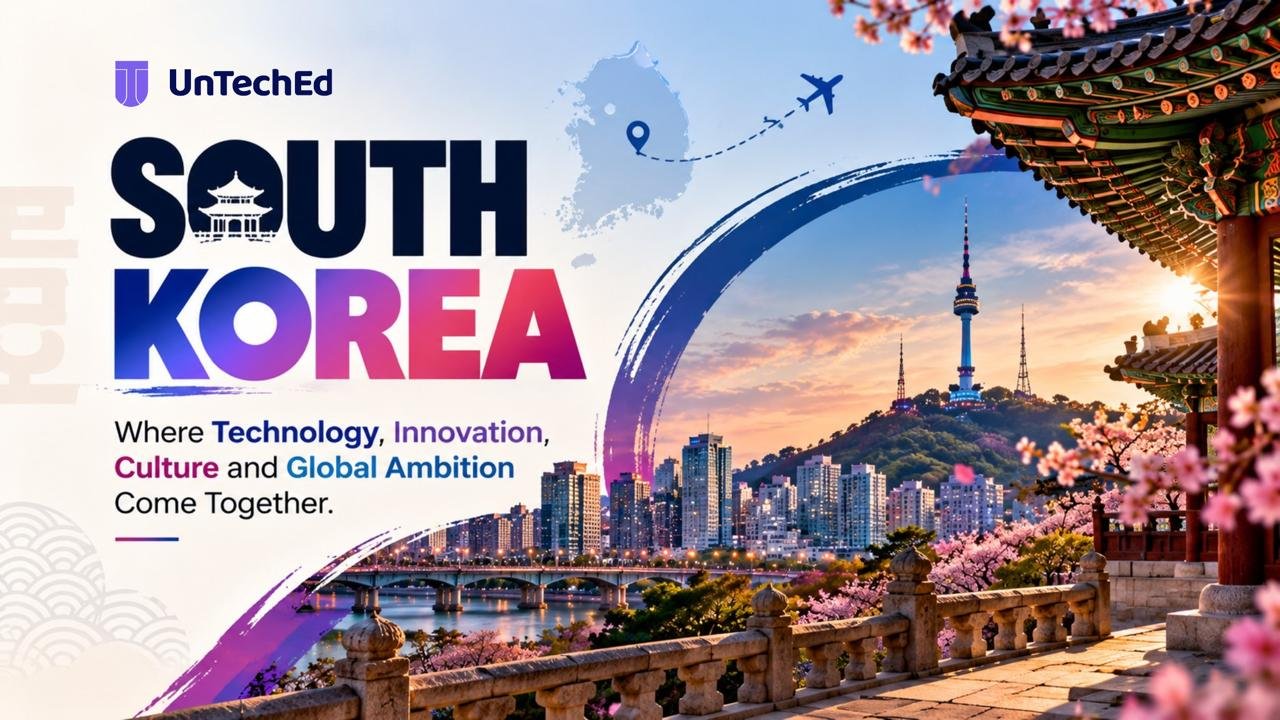
South Korea has become one of the most recognisable countries in the world.
For one generation, Korea was primarily known for its automobiles, electronics and manufacturing.
Today, the country’s global influence extends much further.
Samsung. Hyundai. LG. SK. K-pop. K-dramas. K-Beauty. K-Fashion. Artificial intelligence. Semiconductors. Robotics. Electric vehicles. Gaming. Design. Startups.
South Korea has built an ecosystem where technology, creativity, manufacturing and popular culture exist alongside a strong education system.
That makes the country particularly interesting for international education.
For Indian students, South Korea offers something different from a conventional study-abroad destination.
It is not simply a place to visit.
It is a living classroom for understanding how a country can combine technology, manufacturing, culture, creativity and global branding.
And that makes South Korea increasingly relevant for short-term immersion programmes.
South Korea’s international education ecosystem has expanded significantly.
According to the Korean government’s Study in Korea platform, the number of international students in Korean higher-education institutions reached 253,434 in 2025, compared with 208,962 in 2024. The 2025 population included students in degree programmes as well as Korean-language and other training programmes.
The Korean government actively promotes international education through its Study in Korea platform, which provides information on universities, programmes, scholarships and opportunities for international students.
This growth reflects something important.
South Korea is no longer simply attracting students because of its culture.
It is increasingly attracting students because of the combination of:
Education + Technology + Industry + Culture + Career Exposure
That combination makes it particularly interesting for experiential learning.
A good immersion destination should give students more than sightseeing.
Students should be able to see how businesses operate, how technology is developed, how universities teach, how culture influences industries and how innovation reaches consumers.
South Korea provides all of these within a relatively compact geography.
A student can experience:
Technology
AI, robotics, semiconductors, electronics and digital innovation.
Business
Global Korean companies, startups, retail, finance and entrepreneurship.
Design & Fashion
K-Fashion, beauty, product design, branding and creative industries.
Media & Entertainment
K-pop, K-dramas, gaming and digital content.
Manufacturing
Automobiles, electronics, advanced manufacturing and smart factories.
Culture
Korean history, food, language, architecture and contemporary culture.
This makes the country highly adaptable for multidisciplinary student groups.
Seoul: A Global Classroom
For an international immersion programme, Seoul is particularly powerful.
It is a city where traditional Korea and modern Korea exist side by side.
Students can move from historic palaces and traditional neighbourhoods to technology companies, modern retail districts, universities, startup ecosystems and creative spaces within the same programme.
The city also provides strong opportunities for students interested in:
South Korea’s official tourism organisation also promotes university and campus experiences as part of the country’s growing appeal to international visitors, reflecting the wider interest in Korean university culture and student life.
For students, that creates an opportunity to experience not just Korea as tourists, but Korea as students.
South Korea is an excellent environment for understanding how companies can grow from domestic brands into global businesses.
Students can explore topics such as:
One of the most interesting lessons is the transformation of Korean companies into global brands.
Students can examine how Korean businesses have built international demand not only through products, but through technology, design, branding and cultural influence.
That is a valuable business lesson.
For technology students, South Korea offers a different kind of learning environment.
The country has strong global positions in areas including:
This makes Korea particularly relevant for students studying:
Computer Science | AI & ML | Data Science | Electronics | Robotics | Engineering | Cybersecurity | IoT
An immersion programme can combine university sessions with industry exposure to help students understand how technology moves from research and engineering into commercial products.
Korea’s fashion and beauty industries provide another compelling reason to visit.
The global popularity of Korean culture has helped Korean fashion, cosmetics and lifestyle brands build international audiences.
Students can explore:
The country’s creative industries also demonstrate how culture can become an economic and international branding asset.
For fashion students, Korea therefore becomes more than a destination.
It becomes a case study in how culture, design and commerce can work together.
K-pop and K-dramas are often the first things that make young people interested in Korea.
But the educational opportunity goes much deeper.
Korean culture can be studied through:
The Korean Tourism Organization itself promotes experiences that combine contemporary K-content with traditional culture. For example, Seoul’s HiKR Ground offers interactive experiences around K-pop, Korean street culture and digital technologies including AI and AR.
This creates an interesting educational question:
That question can be explored by students studying business, marketing, media, design and technology.
Korean Language and Cultural Immersion
For students interested in language and cultural learning, Korea offers another advantage: students can experience Korean in its natural environment.
The official Korea Tourism Organization highlights university-based Korean language programmes and study-abroad options for international students.
Even a short immersion can introduce students to:
The objective does not have to be fluency.
It is about understanding how language and culture influence communication.
While Seoul is the natural starting point for many academic programmes, South Korea should not be treated as Seoul alone.
Busan offers a different environment, with its port, maritime economy, beaches and growing cultural profile.
Other destinations can provide exposure to:
The Korea Tourism Organization also highlights destinations such as Busan and Gangwon-do for experiences that combine contemporary development with local culture and natural environments.
For an immersion programme, this creates an opportunity to compare:
Seoul’s metropolitan innovation ecosystem with Korea’s regional industries and culture.
A strong 5–7 day programme could combine academic and experiential learning.
Day 1 — Seoul Orientation & Korean Culture
Day 2 — Technology & Innovation
Day 3 — Business & Industry
Day 4 — K-Culture & Creative Industries
Day 5 — University & Student Experience
Day 6 — Industry / Startup / Innovation
Day 7 — Reflection & Cultural Exploration
The exact structure can change according to the discipline.
One of South Korea’s biggest advantages is its multidisciplinary relevance.
Business Students
Global business, marketing, consumer behaviour, entrepreneurship and corporate strategy.
Technology Students
AI, semiconductors, robotics, cybersecurity and digital transformation.
Engineering Students
Automotive technology, electronics, manufacturing and smart factories.
Fashion Students
K-Fashion, K-Beauty, branding, retail and design.
Media Students
K-pop, entertainment, film, digital content and global media.
Architecture Students
Urban development, smart cities, Korean architecture and design.
Hospitality Students
Tourism, hospitality, food culture and destination management.
This allows universities to potentially bring different schools together for one multidisciplinary global programme.
For Indian students, South Korea provides an interesting Asian perspective.
Students can compare two very different but rapidly developing economies.
India and South Korea both have strong technology ambitions, large consumer markets and globally recognised companies, but their industrial, cultural and economic journeys are very different.
That makes Korea useful as a comparative learning environment.
Students can ask:
How did Korea build global brands?
How did Korean companies scale internationally?
How does Korea connect technology with manufacturing?
How did Korean culture become a global economic force?
What can Indian companies learn from the Korean experience?
These questions make an immersion programme intellectually valuable.
Students do not always need a semester abroad to experience another education and business ecosystem.
A well-designed one-week or two-week programme can introduce them to:
A university + an industry + a culture + a market + a new way of thinking.
The important factor is programme design.
The objective should not be to cover ten tourist attractions.
It should be to create a sequence:
Learn → Observe → Experience → Interact → Reflect
That is what turns international travel into international education.
This is perhaps the strongest reason to consider South Korea for an international immersion programme.
Korea itself can become the subject of study.
How does a country build globally recognised technology companies?
How does culture become a global industry?
How do universities connect education with innovation?
How does design influence consumer behaviour?
How does manufacturing evolve through technology?
How do local companies become global brands?
Students can return from Korea with more than photographs.
They can return with questions, insights and ideas they can apply back in India.
South Korea represents the kind of destination that international education increasingly needs.
It offers students more than a different geography.
It offers a different ecosystem.
A student can study technology in the morning, explore a global business environment in the afternoon and experience Korean culture in the evening.
That combination is what makes immersion powerful.
For Indian universities, South Korea can become a classroom for understanding innovation, technology, global business, creativity and cultural influence.
And for students, it can be an opportunity to look at Asia differently.
Not simply as tourists.
But as learners.
Because the best international programmes do not ask students to simply visit a country.
They ask students to understand why that country works the way it does.
South Korea is not just somewhere to go.
It is something to learn from.
— Sultana Khan
Founder & CEO, UnTechEd
Connecting Institutions for Higher Growth
1. Why should students choose South Korea for an international immersion programme?
South Korea combines technology, business, manufacturing, culture, design and innovation in one highly connected environment.
2. Is South Korea suitable for Indian university students?
Yes. Its universities, industries and creative sectors make it relevant to students from business, technology, engineering, fashion, design, media and hospitality backgrounds.
3. Is South Korea good for technology students?
Yes. Students can explore areas such as AI, semiconductors, electronics, robotics, smart manufacturing and digital transformation.
4. Is South Korea relevant for business students?
Yes. Korean companies provide useful case studies in global expansion, branding, consumer behaviour, innovation and corporate strategy.
5. Is South Korea suitable for fashion students?
Yes. K-Fashion, K-Beauty, retail, branding and creative industries provide strong opportunities for fashion and design students.
6. Can students experience Korean universities?
Yes. South Korea has a large international higher-education ecosystem, and the government’s Study in Korea platform provides information about universities and programmes for international students.
7. Can students learn Korean during a short programme?
A short programme can introduce students to basic Korean language and culture. Longer university language programmes are also available for students seeking deeper study.
8. Is South Korea only about K-pop and K-dramas?
No. K-culture is one part of the country’s global influence. South Korea is also significant in technology, manufacturing, business, engineering, design and innovation.
9. Which city is best for an immersion programme?
Seoul is particularly useful for multidisciplinary programmes because of its concentration of universities, companies, technology, culture and creative industries. Busan can add a different perspective through its maritime and regional economy.
10. How long should a South Korea immersion programme be?
A focused programme can work in approximately 5–7 days, while 10–14 days can allow deeper academic and industry engagement.
11. What makes a South Korea immersion different from tourism?
The difference is the academic structure. University sessions, industry visits, expert interactions, projects and reflection turn travel into learning.
12. What can students bring back from South Korea?
Beyond cultural experience, students can return with insights into innovation, technology, global business, branding, design, manufacturing and cross-cultural collaboration.