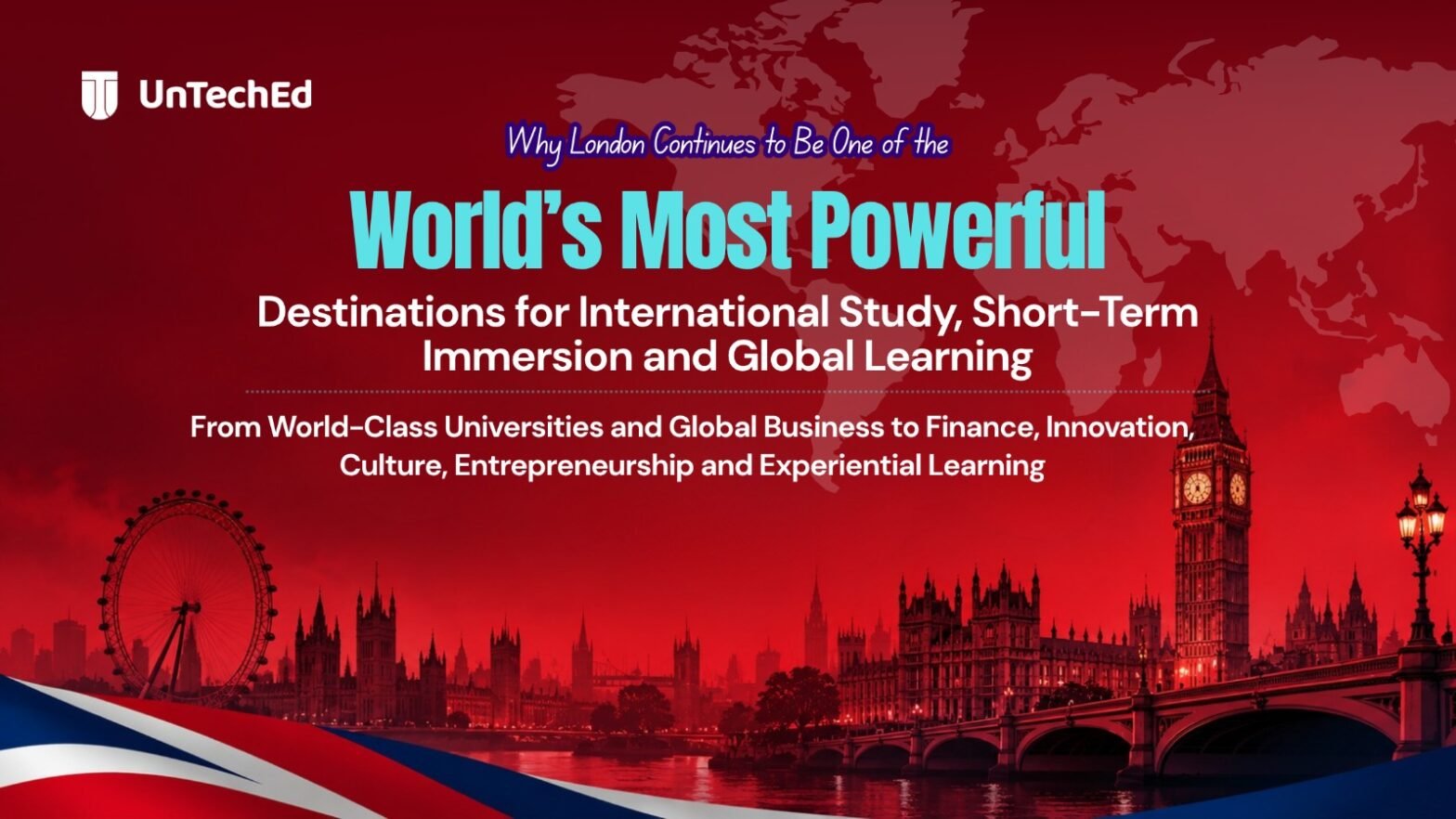
When students think about studying abroad, London is often one of the first destinations that comes to mind.
But London deserves to be understood as much more than a city with famous universities.
It is a city where students can experience, often within the same week:
For an international immersion programme, this combination is extremely powerful.
A student can attend a university lecture in the morning, visit a financial institution or technology company in the afternoon, explore a museum or cultural institution the next day, and discuss entrepreneurship with professionals after that.
The city itself becomes part of the curriculum.
And this is precisely why London remains one of the world’s most valuable destinations for international study, short-term immersion, semester-abroad programmes and global learning.
There are cities where students go primarily to study.
And there are cities where students can study the world itself.
London belongs firmly in the second category.
Why?
Because London’s importance extends across multiple sectors simultaneously.
It is:
A global financial centre
Home to banks, investment firms, insurers, fintech companies and financial institutions.
A technology ecosystem
With growing strengths in AI, fintech, cybersecurity, health technology and digital businesses.
A cultural capital
With museums, theatres, galleries, music, publishing, fashion and creative industries.
A political and diplomatic centre
With the UK government, Parliament, embassies and international organisations.
A business hub
With headquarters and offices of global companies.
A research ecosystem
Connected to some of the world’s leading universities and research institutions.
A startup ecosystem
With entrepreneurs, accelerators, venture capital and innovation networks.
This creates something particularly valuable for students:
The ability to connect academic knowledge with the real world.
London’s educational ecosystem is one of its greatest strengths.
The city is home to internationally recognised institutions including:
The QS World University Rankings 2026 place several London institutions among the world’s leading universities.
Imperial College London is ranked #2 globally, while University College London is #9, King’s College London #31, and the London School of Economics and Political Science #56.
But rankings tell only part of the story.
The more important advantage is density.
London allows students to access multiple universities, industries, organisations and cultural institutions within one metropolitan ecosystem.
Imagine a student studying:
Business.
They can study corporate strategy at university.
Then visit a global company.
Then attend a startup event.
Then explore the financial district.
Then speak with an entrepreneur.
Then analyse London’s retail and consumer markets.
The academic concept becomes connected to real-world observation.
The same applies to engineering.
A student can study:
AI → visit a technology ecosystem → understand commercial applications → discuss ethics → observe digital transformation.
That is experiential learning.
London for Indian Students
London has a particularly strong relationship with India.
There are extensive educational, cultural, economic and professional connections between the UK and India.
For Indian students, London can therefore provide something valuable:
Indian students can encounter:
This creates an interesting transition for students who are travelling abroad for the first time.
They can experience a highly international city without feeling completely disconnected from their cultural environment.
London Is One of the World’s Most International Cities
London’s international character is one of its greatest educational assets.
Students from around the world study and work in the city.
According to London’s economic development agency, London is home to people from more than 200 countries and territories, with hundreds of languages spoken across the capital.
For students, this creates an important learning opportunity.
They don’t simply interact with British students.
They interact with:
Europeans + Asians + Africans + Americans + Middle Eastern students + Latin Americans + international professionals.
That is effectively a practical course in:
Cross-cultural communication.
And cross-cultural communication is becoming increasingly important in the global workplace.
London for Business Students
If there is one subject for which London is particularly powerful, it is:
Global Business.
London is home to:
The City of London and Canary Wharf together create one of the world’s most important financial and business ecosystems.
For business students, London can become a living classroom for:
London has long been one of the world’s most important financial centres.
The City of London Corporation describes the UK capital as a leading international financial centre with major strengths across banking, insurance, asset management, capital markets and professional services.
For finance students, this creates a unique opportunity.
Instead of learning only about:
financial markets
students can see the physical ecosystem around them.
They can explore:
This turns financial theory into something tangible.
London for FinTech
One of London’s most interesting modern stories is fintech.
The city has developed a strong ecosystem around:
This is particularly relevant to students because finance is changing rapidly.
The question is no longer:
“What is banking?”
It is increasingly:
“What will banking look like in a digital economy?”
London gives students the opportunity to explore that question within a mature financial ecosystem.
London for Entrepreneurship
London is also one of Europe’s major startup centres.
Students can encounter:
This creates an important learning opportunity.
Students can understand that entrepreneurship is not simply about having an idea.
It is about:
Idea → market → customer → funding → team → technology → scale.
A short-term programme can introduce students to this ecosystem in a very practical way.
London’s technology ecosystem has expanded significantly.
The UK government has identified London as one of the country’s major technology and AI centres.
Students can explore areas such as:
This creates opportunities for students from:
Computer Science + Engineering + Business + Data Science + Design + Economics.
AI Is Changing London’s Education and Business Ecosystem
Artificial intelligence is becoming one of the defining technologies of the decade.
London provides an interesting environment for studying not only AI technology, but its broader implications.
Students can explore:
AI + Business
How businesses use AI to improve productivity.
AI + Finance
How financial institutions use data and algorithms.
AI + Healthcare
How technology can transform diagnosis and healthcare delivery.
AI + Education
How universities are adapting to generative AI.
AI + Ethics
What happens when technology makes decisions affecting people?
This is where an international immersion programme can become much more sophisticated.
The goal isn’t simply to “visit an AI company.”
It is to understand:
How AI changes organisations, industries and society.
London for Engineering Students
London may not immediately come to mind when students think about manufacturing-heavy destinations such as Germany, Japan or China.
But its strength is different.
London is particularly strong for:
And its proximity to major UK research and technology ecosystems makes it valuable for engineering students.
Imperial College London, for example, is internationally recognised for engineering, science, medicine and business.
This allows engineering programmes to combine:
Academic learning + research + entrepreneurship + industry.
London for Healthcare and Life Sciences
London is also one of Europe’s important healthcare and life-sciences ecosystems.
Students can explore:
The city is home to major teaching hospitals and research institutions.
This makes London particularly interesting for:
Healthcare + Business + Technology
programmes.
Students can examine how medical research moves from:
Laboratory → clinical environment → healthcare system → patient.
London for Law Students
London is particularly relevant for students studying law.
Why?
Because the UK legal system has significant global influence, and London is a major international legal centre.
Students can explore:
London also provides exposure to the broader relationship between:
Law + Business + Government + International Trade.
For law students, this can be considerably more valuable than simply attending a lecture on British law.
London offers an extraordinary environment for students studying:
Students can explore institutions such as:
The city allows students to observe how policy is discussed, developed and communicated.
London for Media and Communications
London is also a major global media centre.
Students can explore:
The city has historically been home to major international media organisations and creative companies.
For communications students, this provides an opportunity to understand:
How does a story become global?
London for Creative Industries
London’s creative economy is another major strength.
Students can explore:
Institutions such as the University of the Arts London contribute to the city’s international creative identity.
For students studying creative disciplines, London is not simply a destination.
It is an industry ecosystem.
London for Fashion Students
London is one of the world’s recognised fashion capitals.
Students can study:
And they can see how fashion interacts with:
Culture + Business + Media + Technology.
London for Architecture Students
London is one of the best cities in the world to study architecture and urban development.
Why?
Because the city contains layers of development spanning centuries.
Students can observe:
Historic architecture
alongside:
Victorian infrastructure
alongside:
Modern commercial districts
alongside:
Contemporary architecture
alongside:
Regenerated urban spaces.
This creates an exceptional urban laboratory.
Students can study:
London as a Sustainability Classroom
London also provides opportunities to explore sustainability within a major global city.
Students can study:
The larger question becomes:
How does a major global city become more sustainable without sacrificing economic competitiveness?
This is relevant to almost every rapidly growing city in the world, including Delhi, Mumbai, Bengaluru and Hyderabad.
London and India’s Urban Future
This creates an interesting comparative learning opportunity.
Students can compare:
London
with
Delhi
or
Mumbai
or
Bengaluru
on questions such as:
International education becomes more meaningful when students return home able to ask:
What can we adapt?
London’s Museums Are Classrooms Too
One of London’s greatest advantages for short-term programmes is its cultural infrastructure.
Students can visit institutions such as:
But these shouldn’t simply be treated as tourist attractions.
A museum visit can support academic learning.
For example:
Business students
Can study branding, visitor experience and cultural economics.
Design students
Can analyse visual communication and product design.
History students
Can explore global history.
Science students
Can explore scientific development.
Architecture students
Can study museum architecture.
Media students
Can study storytelling.
This is the difference between:
sightseeing
and
experiential learning.
London for Hospitality and Tourism Students
London is one of the world’s most visited cities and offers a huge tourism ecosystem.
Students can explore:
This can help students understand how a city becomes an international destination.
London for Psychology and Social Sciences
London’s diversity makes it interesting for students studying:
Students can examine:
Again, the city becomes the classroom.
London and the Indian Higher Education Sector
There is another dimension that matters to universities.
London can be an excellent destination for institutional internationalisation.
Indian universities can explore partnerships involving:
This moves the conversation beyond:
“Where can we send students?”
towards:
“How can our university become more globally connected?”
Short-Term Immersion vs Semester Abroad in London
London can work particularly well for both.
Short-Term Immersion
Usually focused on:
A 5–7 day programme can provide an introduction to London’s academic and professional ecosystem.
Semester Abroad
A semester allows students to experience:
The two formats serve different purposes.
A short-term programme should not attempt to replicate a semester.
Instead, it should provide:
high-intensity exposure + focused learning + global perspective.
What Makes London Particularly Good for Short-Term Immersion?
London has one major advantage:
Density.
A large number of relevant institutions and experiences are located within a relatively accessible metropolitan area.
This means a programme can potentially combine:
University
↓
Company
↓
Industry
↓
Cultural institution
↓
Startup
↓
Student interaction
within a short period.
This makes London highly efficient for short international programmes.
What Should a London Immersion Programme Include?
At UnTechEd, we would recommend that universities structure London programmes around six pillars.
1. Academic Learning
A university-hosted lecture, workshop or masterclass.
2. Industry Exposure
Visits to companies or professional organisations relevant to the students’ discipline.
3. Innovation
Exposure to startups, technology ecosystems or entrepreneurship.
4. Cultural Learning
Structured engagement with London’s cultural institutions.
5. International Interaction
Interaction with international students and professionals.
6. Reflection
Students should document and present what they learned.
This produces:
Academic learning + industry exposure + cultural intelligence + career awareness.
What Can Students Learn in 5–7 Days in London?
A well-designed programme can expose students to:
Business
Global business and financial services.
Technology
AI, fintech and digital transformation.
Entrepreneurship
Startups and venture capital.
Law
International business and legal systems.
Media
Global communications and creative industries.
Architecture
Urban development and heritage.
Culture
Museums, arts and multicultural society.
Global Citizenship
Working with people from different cultures.
The objective is not to become an expert in London.
It is to see one’s own academic discipline through a global lens.
London vs Other Major International Study Destinations
Every destination has its own educational proposition.
Singapore
Global business + finance + Asia + efficiency
South Korea
Technology + innovation + culture + global brands
China
Scale + manufacturing + technology + trade
Japan
Technology + manufacturing + culture + sustainability
Dubai
Business + entrepreneurship + luxury + emerging markets
Malaysia
Affordability + multiculturalism + regional connectivity
London
Global business + finance + education + culture + law + technology + international networks
The advantage of London is its breadth.
Why London Can Be Particularly Valuable for Indian Students
London can expose Indian students to an environment where:
British institutions
European markets
Asian communities
African businesses
Middle Eastern capital
American corporations
global technology
all interact.
That is what makes the city truly international.
Students learn that globalisation isn’t an abstract concept.
It is something they can observe every day.
What Should Parents Ask Before Choosing a London Programme?
Parents should ask:
And most importantly:
What will my child learn that they could not learn simply by travelling to London independently?
That is an excellent question.
What Should Students Ask?
Students should ask:
Academic
Will this programme add something to my degree?
Industry
Will I meet professionals?
Career
Will I understand my industry better?
Global
Will I interact with students from other countries?
Personal
Will this experience challenge my assumptions?
Practical
Will I return with skills, knowledge or networks?
Is London Expensive for International Students?
London is generally considered one of the more expensive major student cities.
Costs depend significantly on:
This is particularly important for short-term immersion programmes.
Students and parents should look at the complete programme cost, including:
rather than comparing only tuition or programme fees.
Are Scholarships Available?
Yes.
UK universities offer a variety of scholarships and funding opportunities, although eligibility varies significantly by university, nationality, academic level and programme.
For longer-term study, students should explore university-specific scholarship opportunities as well as UK government-supported schemes where applicable.
Is London Safe for International Students?
London is a major global city and millions of students, residents and visitors live and study there.
However, like any major city, students should understand:
A structured university or institutional programme should provide appropriate guidance and supervision.
Is London Suitable for First-Time International Travellers?
It can be.
The city has:
However, students should still be prepared for independent movement, time management and responsibility.
That is actually part of the educational experience.
1. Is London a good destination for international students?
Yes. London combines globally recognised universities with major business, finance, technology, cultural and professional ecosystems.
2. Why should Indian students choose London?
London provides global exposure, strong universities, multicultural interaction and access to international business and professional networks.
3. Is London good for short-term immersion programmes?
Yes. The city’s high concentration of universities, companies, cultural institutions and professional organisations makes it particularly suitable for short, intensive programmes.
4. Is London good for business students?
Very much so. Finance, consulting, entrepreneurship, marketing, fintech and international business are particularly strong areas.
5. Is London good for engineering students?
Yes, particularly for AI, biomedical engineering, digital technologies, infrastructure, sustainability and research.
6. Is London good for MBA students?
Yes. London offers exposure to finance, consulting, global companies, entrepreneurship and international business.
7. Is London good for finance students?
London is one of the world’s major financial centres, making it particularly relevant for finance and economics students.
8. Is London good for law students?
Yes. London is a major international legal centre and provides exposure to commercial law, arbitration, corporate law and financial regulation.
9. Is London good for architecture students?
Yes. The city offers an exceptional combination of historic architecture, modern development, urban planning and regeneration.
10. Is London good for media students?
Yes. London’s media and creative industries provide opportunities to study journalism, publishing, advertising, film, television and digital media.
11. Is London good for fashion students?
Yes. London is one of the world’s recognised fashion and creative capitals.
12. Which are some of London’s leading universities?
Imperial College London, University College London, King’s College London and LSE are among the city’s globally ranked institutions.
13. Is London expensive?
It can be. Students should carefully budget for accommodation, transport, food and other living expenses.
14. Can students study in London in English?
Yes. English is the primary language of instruction at UK universities.
15. Is London good for entrepreneurship?
Yes. The city has a large startup, venture capital and innovation ecosystem.
16. Is London good for AI?
Yes. London’s technology ecosystem includes significant activity in artificial intelligence, fintech, health technology and digital businesses.
17. Can students visit companies during a London immersion programme?
Yes, depending on the programme and institutional arrangements. Industry exposure should ideally be aligned with students’ academic disciplines.
18. Can universities in India collaborate with London universities?
Yes. Potential models include student exchange, faculty exchange, research collaboration, joint programmes, short-term immersion and academic workshops.
19. Is a short-term London programme useful for employability?
It can be, particularly when students gain meaningful academic, professional and intercultural exposure.
20. What makes London different from other international destinations?
Its combination of world-class education, finance, business, culture, law, technology and international diversity makes it unusually broad as a learning environment.
21. How long should a London immersion programme be?
There is no single ideal duration. A focused 5–7 day programme can work well for introductory exposure, while longer programmes allow deeper academic and cultural engagement.
22. Should a London programme include sightseeing?
Cultural and historical experiences can be valuable, but they should be connected to the programme’s academic objectives rather than becoming the primary purpose.
23. What should parents check before sending students?
They should check the academic partner, accommodation, supervision, transport, insurance, visa requirements, emergency arrangements and complete programme inclusions.
24. What should universities look for in a London partner?
Universities should assess academic quality, institutional reputation, programme relevance, student support, industry access and potential for long-term collaboration.
25. Is London suitable for multidisciplinary immersion programmes?
Absolutely. This is actually one of London’s greatest strengths because business, technology, finance, law, media, culture, healthcare and design ecosystems coexist within the same city.
The UnTechEd Perspective: London as a Global Classroom
At UnTechEd, we believe the most meaningful international programmes answer three questions:
What will students learn?
Who will they learn from?
What will they understand differently when they return?
London provides extraordinary opportunities to answer all three.
A business student can understand global markets.
A finance student can see the financial ecosystem.
An engineering student can explore innovation.
A law student can understand international legal systems.
A media student can experience a global creative industry.
A design student can explore fashion, architecture and consumer experience.
A healthcare student can observe a major healthcare ecosystem.
An entrepreneur can experience startup culture.
And every student can learn something broader:
How to operate in a multicultural world.
London Teaches Global Citizenship
Perhaps this is London’s greatest educational advantage.
Students don’t simply meet British people.
They meet the world.
They encounter different:
This develops something that cannot easily be taught through a PowerPoint presentation:
Global competence.
The ability to listen.
The ability to communicate.
The ability to adapt.
The ability to work across cultures.
The ability to question assumptions.
The ability to see problems from different perspectives.
These are becoming essential graduate skills.
The Real Value of a London Immersion Programme
The value isn’t simply:
“I travelled to London.”
The stronger outcome is:
“I studied in a global academic environment.”
“I interacted with people from different countries.”
“I saw how businesses operate internationally.”
“I understood how finance and technology connect.”
“I experienced a different education system.”
“I returned with a broader understanding of my own career.”
That is the difference between international travel and international education.
London as a Classroom
The university is a classroom.
The City of London is a classroom.
Canary Wharf is a classroom.
A startup is a classroom.
A museum is a classroom.
Parliament is a classroom.
A technology company is a classroom.
A theatre is a classroom.
The London Underground is a classroom in urban mobility.
A multicultural neighbourhood is a classroom in global citizenship.
And a conversation with another international student can sometimes be one of the most valuable lessons of the entire programme.
The world has changed dramatically.
New education destinations have emerged.
Asia has developed powerful technology and business hubs.
The Middle East has built new global centres.
But London continues to hold a unique position.
Because London brings together:
Education
Business
Finance
Technology
Law
Culture
Entrepreneurship
Healthcare
Creative industries
Global diversity
within one international ecosystem.
For students, that makes London more than a destination.
It becomes a platform for understanding the world.
And that is why London remains one of the most valuable destinations for international study, short-term immersion and global learning.
The UnTechEd Takeaway
At UnTechEd, we believe students should not simply collect international experiences.
They should build international perspectives.
London can help them do that.
A student can arrive in London with a textbook understanding of:
Business.
Technology.
Finance.
Law.
Design.
Media.
Healthcare.
And return with something more valuable:
Context.
Because once students see their subject operating in a different country, inside a different economy and alongside people from different cultures, their understanding changes.
That is the real purpose of international immersion.
Don’t just visit London. Learn from London.
Don’t just see the world’s global city. Understand the systems that make it global.
Don’t just travel abroad. Return with a wider world view.
— Sultana Khan
Founder & CEO, UnTechEd
Connecting Institutions for Higher Growth