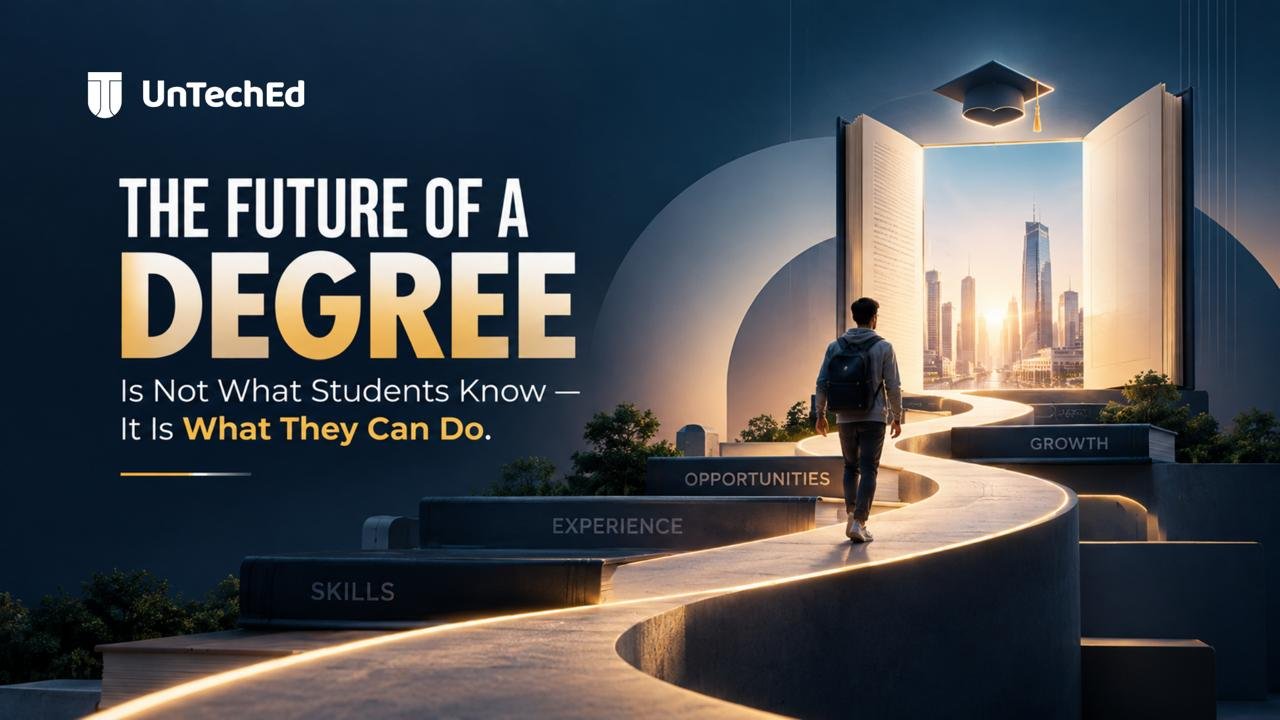
For generations, the university degree represented a relatively simple promise:
Study → graduate → get a job.
Students went to university to acquire knowledge, earn a qualification and enter the workforce.
But that model is being tested by the speed at which the world of work is changing.
Artificial intelligence is changing tasks.
Automation is changing processes.
Globalisation is changing competition.
New technologies are creating new roles while transforming existing ones.
And employers are increasingly looking for people who can learn, adapt and apply knowledge — not simply remember it.
The World Economic Forum’s Future of Jobs Report 2025 estimates that 39% of workers’ existing skill sets will be transformed or become outdated by 2030. Analytical thinking remains one of the most important core skills, while AI and big data, cybersecurity, technological literacy, creative thinking and adaptability are among the capabilities expected to rise in importance.
This raises a fundamental question for higher education:
Are universities preparing students for the jobs that exist today — or for the capabilities they will need tomorrow?
The Degree Still Matters — But Its Meaning Is Changing
This is not an argument against degrees.
Degrees continue to provide academic foundations, professional pathways, intellectual development and recognised qualifications.
The question is what happens inside the degree.
A student can graduate knowing the theories of marketing but struggle to understand a real customer.
An engineering student can understand formulas but have limited experience solving an industrial problem.
A computer science student can learn programming but never work on a real technology project.
A business student can study international markets without ever interacting with someone from another market.
The gap is between:
Knowing and doing.
And that gap is becoming increasingly important.
From Knowledge to Capability
Universities traditionally organise education around subjects.
Students study:
But employers ultimately need people who can perform tasks and solve problems.
That requires capabilities that cut across subjects.
A future-ready graduate may need to be able to:
Analyse a problem.
Use technology intelligently.
Communicate an idea.
Work with a diverse team.
Research independently.
Adapt when circumstances change.
Create something new.
Make decisions with incomplete information.
Understand different markets and cultures.
These capabilities cannot be developed effectively through lectures alone.
They require practice.
The Classroom Cannot Be the Whole Learning Environment
The traditional classroom remains important.
But it cannot be the only place where students learn.
A university should increasingly connect the classroom to:
Industry
Research
Communities
International universities
Startups
Real-world projects
Competitions
Internships
Entrepreneurs
This is where experiential learning becomes important.
A student studying supply-chain management should experience a real supply chain.
A student studying entrepreneurship should work on a real problem.
A technology student should build something.
A fashion student should engage with a real brand or market.
An architecture student should understand how buildings function beyond drawings.
Education becomes more powerful when students have to apply knowledge rather than simply reproduce it.
Artificial intelligence has changed the conversation around knowledge.
Students can now access explanations, summaries, examples, translations, coding assistance and research support almost instantly.
That does not make knowledge irrelevant.
It changes what becomes valuable.
If information is increasingly accessible, universities need to place greater emphasis on:
The World Economic Forum’s 2025 research reflects this combination: technological skills are among the fastest-growing, but human capabilities such as analytical thinking, creative thinking, resilience, flexibility and leadership remain central.
The question is therefore not:
AI or human skills?
It is:
How do universities develop graduates who can use technology while still thinking independently?
The Global Dimension of Capability
There is another capability universities increasingly need to develop:
The ability to work across borders.
A graduate may work with colleagues in India, clients in Singapore, suppliers in China and managers in Europe.
Global work requires more than technical knowledge.
It requires:
This is where internationalisation and employability come together.
International exposure should therefore not be treated simply as travel.
It should be used to develop capability.
A student who works with an international team, visits a foreign company, studies another market and reflects on cultural differences is learning something that cannot be fully replicated through a textbook.
One of the most effective ways to develop capability is through projects.
Imagine a university where students spend part of every semester solving real problems.
A company provides the challenge.
Faculty provide academic guidance.
Students conduct research.
International partners provide another perspective.
Industry experts evaluate the final solution.
Students present their work.
Suddenly, one project develops:
Research + teamwork + communication + technology + problem-solving + presentation + industry awareness.
That is education becoming capability building.
And it does not require the university to reduce academic rigour.
It requires academic knowledge to be put to work.
Universities Need to Rethink Assessment
If we want students to develop capabilities, we also need to rethink how we assess them.
A three-hour examination can measure certain forms of knowledge.
But can it measure:
Not always.
Universities therefore need a broader assessment mix.
Students could be evaluated through:
The objective is not to eliminate examinations.
It is to ensure that assessment reflects the capabilities we claim to value.
Imagine two students graduating with the same degree.
Both have completed the same academic credits.
But one has also:
The second student has accumulated something beyond academic credits:
evidence of capability.
This is where universities can create a much stronger value proposition.
The degree becomes more than a certificate.
It becomes a portfolio of learning and experience.
I believe universities need to think in five layers.
1. Knowledge
What does the student understand?
2. Skills
What can the student do?
3. Experience
Where has the student applied it?
4. Exposure
What different environments has the student experienced?
5. Evidence
Can the student demonstrate what they are capable of?
This creates a much more complete graduate profile.
Knowledge gives the foundation.
Skills enable action.
Experience creates confidence.
Exposure expands perspective.
Evidence creates credibility.
The Role of International Immersion Changes Too
This is also where international immersion programmes need to evolve.
An international trip should not be:
Airport → Hotel → Sightseeing → University visit → Certificate → Airport.
It should be:
Learn → Experience → Interact → Apply → Reflect.
Students should return able to answer:
That is when international exposure becomes capability.
What Should Universities Ask Themselves?
Perhaps every university should periodically ask five questions:
Can our students apply what they learn?
Do students graduate with evidence of what they can do?
Are they comfortable solving unfamiliar problems?
Can they work with people from different backgrounds?
Are we teaching students how to keep learning after graduation?
If the answer to these questions is yes, the university is doing more than producing graduates.
It is building capability.
The future of higher education is not about choosing between academic knowledge and practical experience.
Students need both.
They need strong academic foundations.
But they also need opportunities to apply those foundations in real environments.
This is where universities have an opportunity to rethink the meaning of a degree.
The question should no longer be only:
“What subjects did this student study?”
It should also be:
“What can this student actually do?”
Can they solve a problem?
Can they work with others?
Can they communicate?
Can they use technology?
Can they adapt?
Can they work across cultures?
Can they learn something new when the answer does not already exist?
Because the value of education in the future will not be measured only by how much knowledge a student has accumulated.
It will increasingly be measured by what that knowledge enables the student to do.
The degree is not becoming less valuable.
Its purpose is becoming bigger.