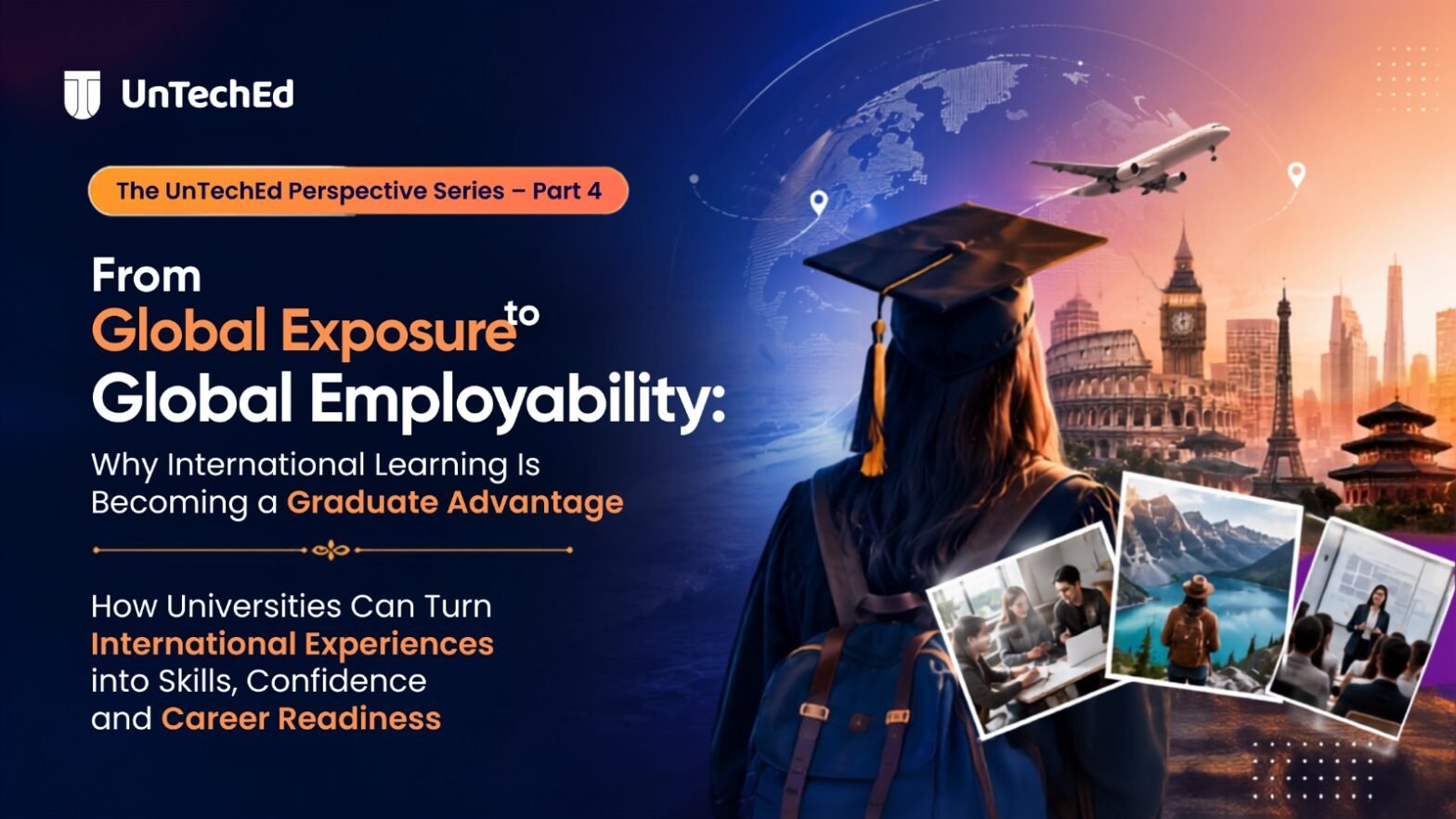
For decades, international education was largely associated with one idea:
Going abroad to study.
A student would complete a degree overseas, return with an international qualification, and hopefully enter a global career.
But higher education is changing.
Today, internationalization is no longer limited to students leaving their home country. It is increasingly about how universities prepare graduates to learn, work, communicate and lead in a world that is inherently international.
The question, therefore, is changing.
It is no longer simply:
It should increasingly be:
What did our students learn from their international experiences, and how did those experiences prepare them for the world of work?
This distinction matters.
Because a passport stamp is not an educational outcome.
A university visit is not automatically a learning outcome.
An international certificate is not automatically an employability advantage.
The real value of internationalization emerges when global experiences are deliberately converted into knowledge, skills, confidence, cultural intelligence, professional networks and the ability to operate in unfamiliar environments.
That is where internationalization and employability meet.
And this is where the conversation around international higher education needs to evolve.
The global employment landscape is undergoing significant transformation.
According to the World Economic Forum’s Future of Jobs Report 2025, job disruption is expected to affect approximately 22% of today’s jobs by 2030, with an estimated 170 million new roles created and 92 million displaced, resulting in a net increase of 78 million jobs. The report also finds that nearly 40% of the skills required on the job are expected to change, while 63% of employers identify skills gaps as a major barrier to business transformation.
This is an important message for higher education.
The challenge facing universities is not simply producing graduates with more knowledge.
It is producing graduates who can continue learning as knowledge, technology, industries and jobs change.
The skills employers increasingly value include both technological and human capabilities.
Artificial intelligence, big data, cybersecurity and technological literacy are growing in importance.
At the same time, employers continue to place significant value on:
The World Economic Forum’s research highlights precisely this combination of technological and human capabilities.
This creates a challenge for universities.
How do we teach students to become adaptable?
How do we help them become comfortable with uncertainty?
How do we teach them to communicate across cultures?
How do we develop graduates who can enter an unfamiliar environment and still perform effectively?
Some of these capabilities cannot be developed effectively through lectures alone.
They need experience.
And international exposure can become one of those experiences.
This distinction is fundamental.
A student can travel to Singapore, Malaysia, Dubai, Japan, Vietnam, Indonesia or any other country without necessarily becoming more globally competent.
Travel creates exposure.
Learning requires intentionality.
Consider two students.
Student A
Travels overseas.
Visits a university.
Takes photographs.
Visits tourist attractions.
Returns home.
Student B
Travels overseas.
Attends academic sessions.
Works with international students.
Visits companies.
Participates in a problem-solving activity.
Discusses cultural differences.
Reflects on how businesses operate differently.
Presents what they learned.
Both travelled.
But the educational outcomes can be completely different.
The second experience has the potential to develop:
This is why the design of an international programme matters more than the destination alone.
From “Study Tour” to Experiential Learning
The language we use matters.
For many years, international group programmes were described as:
study tours
or
educational tours.
There is nothing inherently wrong with these terms.
But higher education needs to move toward a more outcome-oriented model.
A meaningful international immersion should answer four questions:
What will the student learn?
Who will the student interact with?
What will the student experience?
What will the student be able to demonstrate afterwards?
That changes the programme from a travel experience into an experiential learning intervention.
A strong international programme can therefore follow a simple model:
Prepare → Experience → Interact → Apply → Reflect → Demonstrate
The student is prepared before travelling.
The student experiences an unfamiliar environment.
The student interacts with academics, industry professionals and peers.
The student applies classroom knowledge to real situations.
The student reflects on the experience.
And finally, the student can demonstrate what they have learned.
That final step is often missing.
A degree remains important.
But a degree alone does not guarantee that a graduate can navigate the complexity of the modern workplace.
The OECD describes international student mobility as having the potential to provide access to experiences and skills that may not be developed domestically and notes its relevance to international career opportunities and employability in a globalised labour market.
This does not mean every student needs to study abroad for a full degree.
It means that international learning can complement academic education by exposing students to different environments, people, practices and perspectives.
Imagine a business student who understands international marketing in theory.
Now place that student inside a Singaporean company.
Ask them to observe how the company approaches customers from different countries.
Or consider an engineering student learning about smart infrastructure.
Now allow that student to see how another country approaches urban mobility.
Or a hospitality student studying destination management.
Now let them observe how a country builds its tourism ecosystem.
The classroom provides the framework.
The international environment provides the context.
And the combination can produce deeper learning.
The graduate of the future will increasingly need to operate across boundaries.
These boundaries may be:
A graduate may work for an Indian company serving customers in Europe.
A software engineer in Bengaluru may work with a team in Singapore.
A marketing professional in Mumbai may manage campaigns across Southeast Asia.
An entrepreneur in Delhi may build a company serving customers globally.
A researcher in India may collaborate with institutions across several countries.
Global work does not necessarily require global relocation.
This is why international competence should not be treated as an optional extra.
Seven Skills International Learning Can Help Develop
Students learn that communication is not simply about language.
It is also about:
Working with people from different backgrounds helps students understand that their own way of communicating is not the only way.
That is a powerful professional lesson.
An international environment removes students from many familiar routines.
They have to navigate:
These experiences can encourage students to become more comfortable with uncertainty.
That matters enormously in the modern workplace.
Confidence is not simply the ability to speak loudly.
It is the ability to say:
“I don’t know this environment yet, but I can learn.”
International experiences can create precisely these situations.
Students have to ask questions.
They have to communicate.
They have to make decisions.
They have to navigate unfamiliar circumstances.
Each successful interaction builds confidence.
Real life rarely provides multiple-choice answers.
A delayed flight.
A communication challenge.
An unfamiliar process.
A group disagreement.
A business problem.
An unexpected change in schedule.
These situations require students to think rather than simply recall.
International experiences can therefore become opportunities for practical problem-solving.
International programmes can bring together students from different:
Learning to work with people who think differently is an increasingly important professional capability.
Cultural intelligence is the ability to understand and function effectively across different cultural contexts.
For global employers, this can be extremely valuable.
A culturally intelligent graduate is more likely to ask:
“Why does this person see the situation differently?”
rather than:
“Why don’t they understand?”
That shift in mindset can make a significant difference in international workplaces.
Perhaps the most underrated outcome of international exposure is curiosity.
Students discover that there are different ways to:
Once students realise that their way is not the only way, they become more open to learning.
And in a world where skills are changing rapidly, that mindset may be one of the most valuable capabilities of all.
This discussion is particularly relevant for India.
The National Education Policy 2020 places significant emphasis on the internationalization of higher education.
The Government of India’s implementation framework highlights research collaboration, student exchanges and programmes between Indian and global institutions as mechanisms for developing research and innovation and achieving global standards of quality. It also explicitly discusses internationalization at home.
This is important because it signals a broader shift.
Indian higher education is not simply being encouraged to send students overseas.
Indian institutions are being encouraged to become globally connected institutions.
That means internationalization needs to become part of:
One of the biggest challenges is accessibility.
If only a small percentage of students can afford a semester abroad, universities need to think about how the benefits of internationalization can reach a much larger student population.
This is where different models become important.
Universities can consider:
Short-Term International Immersion
Five-to-seven-day academic programmes combining university sessions, industry exposure and cultural learning.
Semester Exchange
Longer academic mobility with credit recognition.
Faculty Exchange
Creating international exposure for educators.
International Guest Lectures
Bringing international academics and professionals into classrooms.
Virtual Exchange
Connecting students across countries without requiring physical travel.
Collaborative Projects
Students from two countries working together on a common academic or industry problem.
Internationalization at Home
Embedding global perspectives into the curriculum and campus experience.
The objective should be to create multiple pathways to global learning.
What Does a Good International Immersion Programme Look Like?
A high-quality programme should begin long before the flight.
Before the Programme
Students should understand:
This creates preparation.
During the Programme
Students should experience a balance of:
Academic Learning
University lectures, workshops and discussions.
Industry Exposure
Company visits, business meetings and professional interactions.
Peer Learning
Interaction with students from different countries.
Cultural Learning
Understanding the destination beyond tourism.
Experiential Learning
Projects, challenges, observations and real-world activities.
After the Programme
This is where universities can create even greater value.
Students can be asked to:
The experience then becomes part of the student’s academic journey rather than a standalone trip.
One of the most common mistakes students make is writing:
“Participated in a Singapore International Immersion Programme.”
That tells an employer almost nothing.
Instead:
Analysed digital transformation practices through academic sessions and industry exposure; collaborated with a multicultural student team and presented recommendations on emerging business models.
The second version communicates:
That is the difference between participation and achievement.
Parents should not evaluate programmes only by destination or price.
A better set of questions is:
What will my child actually learn?
Which university is hosting the academic component?
Are there structured academic sessions?
Will students interact with faculty?
Is there industry exposure?
Are there measurable learning outcomes?
Is there a project or assessment?
How is student safety managed?
What is included in the fee?
What happens after students return?
A programme costing less is not necessarily better.
A programme costing more is not automatically better either.
The real question is:
What is the educational value being created?
What Should Universities Measure?
This is where internationalization needs to become more strategic.
Many institutions still measure internationalization through:
These are useful activity indicators.
But universities should increasingly measure outcomes.
For example:
Student Outcomes
Academic Outcomes
Career Outcomes
Institutional Outcomes
The question should move from:
“How many international activities did we conduct?”
to:
“What changed because of those activities?”
Employability should not sit separately from internationalization.
The two can reinforce one another.
A university that creates strong international partnerships can give students access to:
UNESCO has also highlighted the importance of aligning higher education with changing labour markets and strengthening relationships with employers and other stakeholders to improve graduate employability.
This is why internationalization should increasingly be viewed as part of the student success ecosystem.
Artificial Intelligence is changing how work is performed.
Students can now access information, generate content, analyse data and automate tasks at unprecedented speed.
But this creates an interesting paradox.
As technology becomes more capable, distinctly human capabilities may become more valuable.
Students still need to know how to:
International experiences can contribute to these capabilities because they place students in contexts where there is no simple algorithm for understanding another person or culture.
AI can translate a language.
It cannot automatically give a student cultural intelligence.
AI can provide information about another country.
It cannot replace the experience of standing in a different environment and trying to understand how people live, work and think.
That distinction will become increasingly important.
This may be the most important point of this article.
The future of internationalization should not simply mean:
more students travelling to more countries.
It should mean:
more students gaining meaningful global competencies.
Travel is one pathway.
But not the only pathway.
The university of the future may combine:
Physical mobility
Virtual international collaboration
International faculty
Global curriculum
Industry partnerships
International research
Internationalization at home
to create a much broader global learning ecosystem.
UNESCO reports that around 7.3 million students are internationally mobile, while the global higher education population has grown to hundreds of millions.
This highlights an important reality:
Only a fraction of the world’s students will physically study abroad.
Therefore, universities need internationalization models that reach students where they are.
From Global Exposure to Global Employability
The journey can be understood simply:
Exposure
Students encounter a new country, culture or institution.
↓
Experience
They interact with people, organisations and unfamiliar environments.
↓
Reflection
They think critically about what they observed.
↓
Skill Development
They develop communication, adaptability, teamwork, problem-solving and cultural intelligence.
↓
Demonstration
They can articulate and demonstrate those skills.
↓
Employability
Those capabilities become relevant to future academic and professional opportunities.
This is the transition we need to encourage.
The Role of Universities
Universities have an opportunity to redesign internationalization around student outcomes.
Instead of asking:
“Where can we send students?”
ask:
“What capabilities do we want our graduates to develop?”
Then work backwards.
If the desired capability is cross-cultural communication, create multicultural teamwork.
If the desired capability is entrepreneurship, arrange interaction with entrepreneurs.
If the desired capability is international business understanding, connect students with companies.
If the desired capability is research, connect students with international academics.
If the desired capability is leadership, design collaborative challenges.
The destination becomes the learning environment.
The programme becomes the learning architecture.
And the student becomes the centre of the experience.
Perhaps we need to rethink what internationalization means.
Internationalization is not simply:
students crossing borders.
It is:
ideas crossing borders.
knowledge crossing borders.
research crossing borders.
cultures crossing borders.
innovation crossing borders.
And ultimately:
students learning to cross intellectual, cultural and professional boundaries.
That is a much more powerful definition.
International exposure can contribute to employability by helping students develop capabilities such as adaptability, communication, teamwork and cultural awareness. However, exposure alone does not guarantee employment. The value depends on the quality, structure and reflection built into the experience. OECD research identifies international mobility as one pathway through which students can acquire skills and access international career opportunities.
No.
International learning can occur through short-term immersion programmes, semester exchanges, international projects, virtual exchange, international classrooms and other forms of mobility.
It can be, if it is academically structured.
A short programme cannot replace a semester abroad, but it can provide focused exposure to universities, industries, cultures and international learning environments.
Not necessarily.
A study tour may focus primarily on visits and observation.
An academic immersion programme should have defined learning objectives, academic sessions, interaction, experiential components and reflection.
Potential outcomes include:
Absolutely.
Indian companies increasingly operate within global supply chains, multinational teams, international markets and technology ecosystems.
Global competence is therefore useful even when a graduate’s workplace is physically located in India.
Yes.
Engineering graduates increasingly work in multidisciplinary and international teams. International exposure can help them understand different approaches to technology, infrastructure, sustainability, innovation and problem-solving.
Business students can benefit significantly from exposure to different markets, consumer behaviour, business models, entrepreneurship ecosystems and management practices.
Absolutely.
International experiences can deepen understanding of culture, history, society, languages, international relations, communication and global issues.
Parents should look beyond sightseeing and examine the academic partner, learning objectives, faculty interaction, industry exposure, programme structure, safety arrangements and post-programme learning activities.
Universities can measure student learning, intercultural competence, academic outcomes, industry engagement, research collaboration, employability indicators and the effectiveness of partnerships.
Internationalization at Home refers broadly to creating international and intercultural learning opportunities for students who may not physically travel abroad. It can include international curriculum content, international faculty, virtual exchanges, collaborative projects and multicultural campus activities. India’s NEP 2020 internationalization framework explicitly recognises this approach.
No.
Travel provides exposure.
Learning requires reflection, interaction and intentional educational design.
Students should describe the activity, their responsibilities, the problem or project involved and the skills developed rather than simply stating that they travelled.
A future-ready programme should connect academic learning with real-world experience and develop capabilities such as adaptability, critical thinking, communication, teamwork, cultural intelligence and digital awareness.
Yes, but reputation should be a consequence of meaningful academic activity rather than the sole objective.
Strong partnerships, research, faculty collaboration, student outcomes and international engagement can contribute to institutional reputation over time.
Universities should develop international relationships that align with their academic strengths and strategic objectives rather than collecting partnerships simply for their numbers.
They can combine physical mobility with Internationalization at Home, virtual exchange, short-term programmes, scholarships, faculty-led programmes and international projects so that global learning is available to a broader student population.
Not necessarily.
As AI handles more information-based tasks, human capabilities such as communication, adaptability, cultural understanding, collaboration, creativity and judgement may become increasingly important.
Treating internationalization as an activity rather than an institutional strategy.
The objective should not simply be to conduct more international programmes.
It should be to create better learning, stronger partnerships and better graduate outcomes.
For institutions beginning or strengthening their internationalization journey, five actions can make a meaningful difference.
Identify the global capabilities students should develop.
Do not start with the destination.
Start with the learning objective.
Bring employers, companies and professionals into international programmes.
Move beyond counting participants.
Measure outcomes.
Combine mobility with Internationalization at Home and virtual/global collaboration.
At UnTechEd, our experience working with universities and students across different international destinations has reinforced one belief:
International exposure is most valuable when it changes the way a student thinks.
The destination matters.
The university matters.
The academic sessions matter.
The industry visits matter.
But what matters most is what the student takes back.
Does the student become more curious?
More confident?
More adaptable?
More comfortable working with people from different cultures?
More willing to question assumptions?
More capable of seeing a problem from multiple perspectives?
If the answer is yes, then internationalization has achieved something meaningful.
Because the purpose of international education should not be to create students who have simply seen more countries.
It should be to create graduates who can understand more perspectives.
The next decade will not simply reward students who know the most.
It will increasingly reward those who can learn, adapt, collaborate and apply what they know in changing environments.
Universities therefore have a responsibility to create learning environments that prepare students for this reality.
Internationalization can be one of the most powerful tools available to them.
But only if we move beyond the traditional definition of mobility.
The question is no longer:
“Did the student go abroad?”
The question is:
“Did the student grow because they went abroad?”
And eventually:
“Can the student demonstrate what they learned?”
That is where international exposure becomes global employability.
And that is where internationalization moves from being an institutional activity to becoming a genuine graduate-outcome strategy.
A passport stamp is an experience.
A new perspective is learning.
A demonstrated capability is an outcome.
When all three come together, internationalization becomes meaningful.
The future of higher education will not belong simply to universities that send the most students abroad.
It will belong to universities that can demonstrate how global experiences help their graduates think better, work better, adapt faster and lead across boundaries.
That is the future of internationalization.
And that is the conversation higher education needs to have now.
— The UnTechEd Perspective
Connecting Institutions for Higher Growth