By Sultana Khan, Founder – Unteched
As higher education continues to evolve in an increasingly interconnected world, universities are looking beyond traditional classrooms to create meaningful international learning opportunities for their students. While destinations such as the United States, Australia, Canada, and the United Kingdom continue to attract students pursuing full degrees abroad, there is a growing demand for shorter, more accessible, and impactful international experiences.
This is where Thailand has emerged as one of Asia’s most valuable destinations for student mobility, academic immersion, and semester abroad opportunities.
Over the years, I have had the opportunity to work with universities, students, and academic leaders across multiple countries. One trend has become increasingly clear: students do not necessarily need to spend years abroad to benefit from international education. Even a one-week, two-week, or four-week international program can create transformative learning experiences that shape perspectives, confidence, and future career aspirations.
Today, Thailand offers the perfect combination of academic excellence, affordability, cultural diversity, industry exposure, and accessibility, making it an ideal destination for universities seeking to internationalize student learning experiences.
For many years, international education was viewed primarily through the lens of full-degree programs overseas. While these opportunities remain valuable, the reality is that not every student wishes to pursue a complete degree abroad, nor does every family have the financial flexibility to support such a pathway.
However, every student deserves the opportunity to gain international exposure.
Short-term programs and semester abroad initiatives have become powerful tools for universities seeking to provide global learning experiences without requiring students to commit to long-term overseas study.
These programs allow students to:
Most importantly, students return home with broader perspectives and a deeper understanding of the world around them.
Thailand occupies a unique position within one of the world’s most dynamic and rapidly growing regions.
As a member of ASEAN, Thailand provides students with exposure to regional economies, international business environments, manufacturing hubs, digital innovation ecosystems, and multicultural societies.
For students studying business, management, technology, engineering, hospitality, tourism, international relations, and entrepreneurship, Thailand offers practical insights into how global industries operate in Asia.
Thailand has invested heavily in higher education and internationalization over the past decade.
Universities have expanded international partnerships, introduced English-medium programs, welcomed international faculty, and created learning environments that encourage collaboration across cultures.
Students participating in programs at institutions such as DPU Thailand and other internationally engaged universities gain exposure to diverse teaching styles, project-based learning approaches, and global classroom experiences.
The result is learning that extends far beyond textbooks.
One of Thailand’s greatest strengths is its ability to offer high-quality international experiences at a significantly lower cost than many traditional study destinations.
This makes international learning accessible to a broader range of students and allows universities to create mobility opportunities for larger student cohorts.
Affordable accommodation, transportation, food, and program costs enable institutions to focus resources on learning outcomes rather than excessive travel expenses.
Students today need more than academic knowledge. Employers increasingly seek graduates who understand how industries operate in real-world environments.
Thailand offers opportunities to explore sectors including:
Industry visits, expert interactions, and practical projects provide students with valuable exposure to professional environments and emerging global trends.
Perhaps one of the most overlooked benefits of international programs is cultural learning.
In today’s workplace, professionals collaborate across countries, cultures, languages, and time zones.
Students who have experienced international environments often develop:
These qualities are increasingly becoming essential career competencies.
One of the most common questions universities and parents ask is:
“What do students really learn from short-term international programs?”
The answer extends far beyond academic content.
Academic Outcomes
Professional Outcomes
Personal Outcomes
These outcomes often remain with students long after the program has concluded.
The answer depends on the student’s goals.
Short-Term Programs | Semester Abroad |
1–4 Weeks | 3–6 Months |
Ideal for first-time international exposure | Ideal for deeper immersion |
Cost-effective | Greater academic integration |
Focus on exposure and experiential learning | Focus on academic progression and credit transfer |
Suitable for larger student groups | Suitable for students seeking extended international experience |
Both models play an important role in preparing students for a global future.
Myth 1: International Programs Are Only for Students Planning to Study Abroad
Reality:
International exposure benefits students regardless of where they ultimately build their careers. Global perspectives are valuable whether students remain in India or work internationally.
Myth 2: A One-Week or Four-Week Program Is Too Short
Reality:
Even short-term programs can significantly improve confidence, communication skills, cultural awareness, and global understanding.
Myth 3: International Programs Are Simply Educational Tourism
Reality:
Well-designed programs combine academic learning, industry engagement, cultural immersion, and experiential activities to create meaningful learning outcomes.
Myth 4: Students Learn the Same Things Online
Reality:
No virtual classroom can fully replicate the experience of living, studying, interacting, and collaborating in an international environment.
Myth 5: International Learning Is Only for High-Achieving Students
Reality:
International exposure benefits students from all academic backgrounds by helping them develop essential life and career skills.
Q1. What is the ideal duration for a short-term international program?
Programs ranging from one to four weeks provide a strong balance between affordability, academic value, and cultural immersion.
Q2. Is Thailand suitable for first-time international travellers?
Yes. Thailand is one of the most welcoming, accessible, and student-friendly destinations in Asia.
Q3. What disciplines benefit most from these programs?
Business, Management, Technology, Engineering, Hospitality, Tourism, Design, Healthcare, and Social Sciences all benefit significantly from international exposure.
Q4. Can students receive academic credits?
Many semester abroad and selected short-term programs can be structured with credit-bearing opportunities depending on institutional agreements.
Q5. Are international programs only about academics?
No. Some of the most valuable learning occurs through cultural experiences, peer interactions, industry visits, and personal growth.
Q6. How do employers view international exposure?
Employers increasingly value graduates who demonstrate adaptability, global awareness, communication skills, and the ability to work across cultures.
Q7. What is the biggest benefit students take home?
Confidence.
Students return with greater self-belief, broader perspectives, stronger communication skills, and a deeper understanding of their own potential.
A Current Example: Learning in Thailand
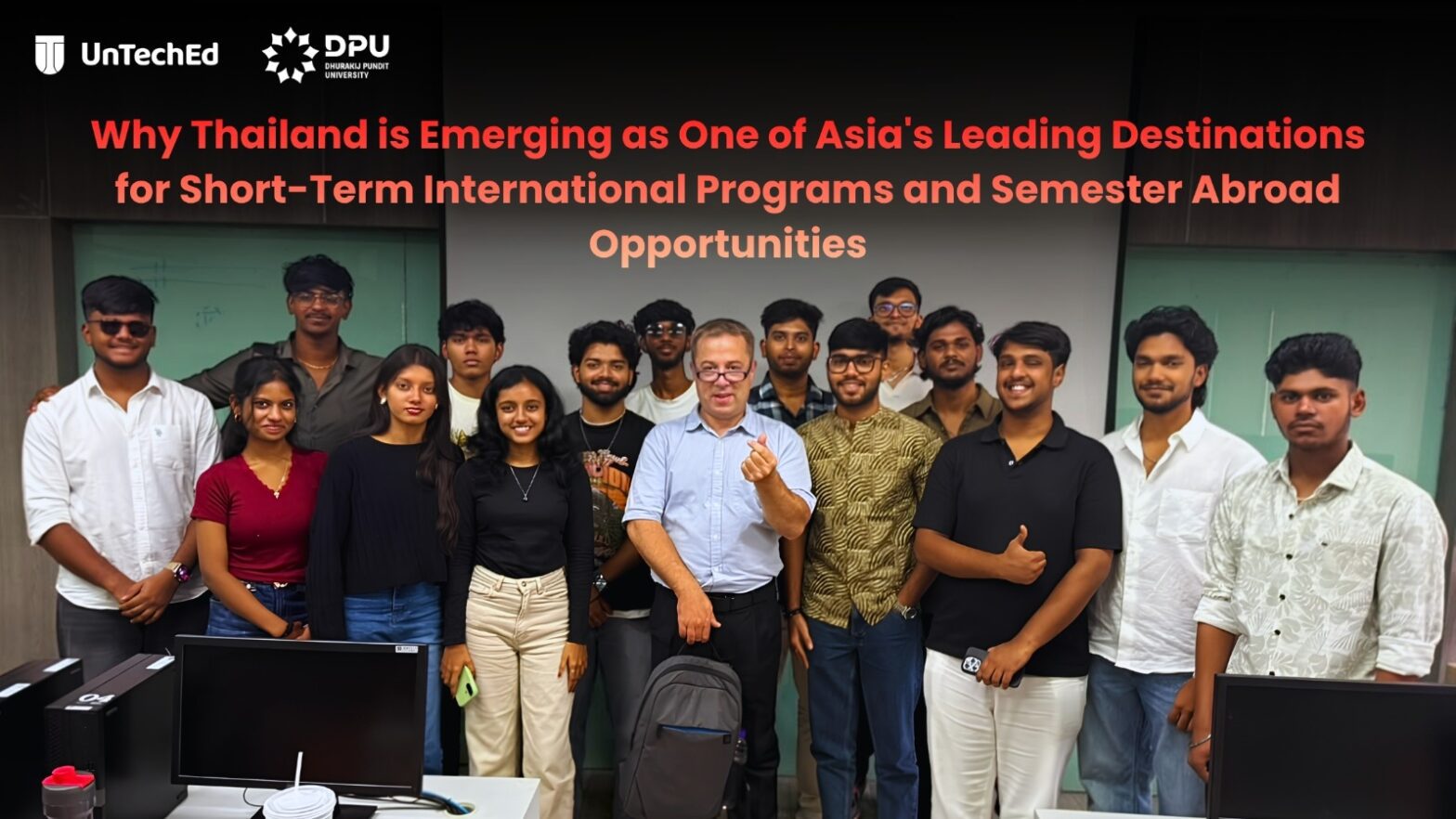
This week, students participating in Unteched’s international mobility initiative commenced their four-week academic program at DPU Thailand.
Over the coming weeks, they will engage in academic learning, collaborative activities, cultural experiences, and international interactions that will contribute to both their personal and professional development.
Their journey reflects a larger movement within higher education—one that recognizes that learning is no longer confined to classrooms or national borders.
Learning in Action: The DPU Thailand Experience
The value of international education is best understood through experience.
In June 2026, students from India joined Dhurakij Pundit University (DPU), Bangkok, for a four-week international academic program that will continue through July 2026.
The program has been designed to provide students with a balanced combination of academic learning, intercultural engagement, international classroom exposure, collaborative projects, and experiential learning opportunities. Beyond the classroom, students are immersed in a new cultural environment, interacting with peers from different backgrounds and gaining a deeper understanding of global perspectives.
For many participants, this represents their first international academic experience. While the program duration may be only four weeks, the learning outcomes often extend far beyond the time spent overseas. Students return with enhanced confidence, stronger communication skills, broader perspectives, and a greater appreciation for the opportunities and challenges of working in an interconnected world.
This initiative reflects a broader shift in higher education, where universities are increasingly recognizing the importance of providing students with meaningful international exposure as part of their academic journey.
Looking Ahead
The future belongs to graduates who can think globally, adapt quickly, collaborate across cultures, and confidently navigate an interconnected world.
Universities have a responsibility to prepare students not only with knowledge but with experiences that help them understand different perspectives, industries, and societies.
Thailand has positioned itself as one of the most effective destinations for achieving these goals.
At Unteched, our mission remains simple: to create meaningful opportunities that allow students to learn beyond borders, broaden their horizons, and return home equipped to make a greater impact in their communities and careers.
Because international education is not about leaving home.
It is about expanding possibilities.

Sultana Khan is the Founder of Unteched and an international higher education specialist with extensive experience in student mobility, international collaborations, admissions, and global education partnerships. Having worked with institutions including James Cook University, MDIS, and ATMC, she is passionate about creating transformative learning opportunities through international immersion programs, university collaborations, faculty development initiatives, and global student engagement.